-
Accelerate AI SecurelyEnable secure AI adoption with visibility, governance, and control across identities, agents, and accessDefend Against AI AttacksProtect your organization from AI-driven threats by securing identities, controlling access, and reducing attack paths.Cyber InsuranceImprove your cyber insurance readiness with stronger identity security, governance, and privileged access controls.RansomwareDefend against ransomware by securing privileged identities, limiting access, and reducing attack paths.Vendor ConsolidationReduce complexity, strengthen security and improve IT ROI through platform consolidation.Secure Remote WorkforceSecure access for employees, contractors, and third parties from anywhere.Reduce Identity RiskGain visibility, control, and continuous authorization across every identity.Financial ServicesReduce identity risk and strengthen governance across financial institutions.HealthcareSecure access to critical systems, patient data, and clinical environments.Federal & PublicSupport secure access, compliance, and operational resilience across public sector enterprises.Energies & Critical InfrastructureProtect critical systems and privileged access across essential infrastructure.EducationProtect your educational institution from ransomware and data misuse.VisibilityDiscover every human, machine, and AI identity across your environment.PostureIdentify excessive privileges, policy gaps, and emerging identity risks.ControlApply authorization and access policies to every identity, session, and action.Human IdentitiesSecure workforce, privileged, and third-party identities.Machine IdentitiesProtect secrets, credentials, certificates, and non-human identities.Agentic IdentitiesGovern and control access for AI agents and autonomous systems.Cloud StatusCheck availability and service health across Delinea cloud services.Customer SupportGet product support, technical guidance, and help from Delinea experts.Identity Security Maturity ModelAssess your identity security maturity and identify priorities for improvement.Professional ServicesAccelerate deployment, adoption, and value with expert implementation and advisory services.Trust CenterAccess Delinea security, privacy, compliance, and assurance information.User TrainingBuild product knowledge and skills with Delinea training and learning resources.
-
The Delinea PlatformA unified identity security platform that protects human, machine and AI identities across your enterprise.Delinea Iris AIAI-powered intelligence that delivers real-time insights, automation and continuous authorization.Secret ServerSecure privileged credentials with enterprise password vaulting and session management.Continuous Identity DiscoveryContinuously discover and inventory every identity across your enterprise.Credential ManagerManage, rotate and protect privileged credentials across hybrid and cloud environments.Fastpath Access GovernanceAutomate access governance, segregation of duties and compliance reporting.Privilege Control for ServersEnforce least privilege and application control across Windows and Linux servers.Privileged Remote AccessProvide secure remote access for employees and third parties without exposing privileged credentialsFull Product ListingBrowse the complete Delinea product portfolio and find the right solution for your enterprise.Why Delinea FastpathDiscover how Delinea Fastpath helps enterprises govern access, reduce risk and strengthen compliance across critical business applications.Delinea Fastpath Access ControlIdentify Segregation of Duties conflicts and sensitive access risk within and across business applications.Delinea Fastpath Access ReviewAutomate user access reviews and generate clear, consistent audit evidence with less manual effort.Delinea Fastpath Change TrackingMonitor critical permission, configuration and data changes across business applications.Delinea Fastpath Access ProvisioningAutomate compliant access requests, approvals, provisioning and deprovisioning.Delinea vs CyberArkCompare Delinea and CyberArk to see how the platforms differ in identity security, deployment and ease of use.Delinea vs BeyondTrustExplore the key differences between Delinea and BeyondTrust across privileged access and identity security.Delinea vs MicrosoftSee how Delinea extends beyond native Microsoft capabilities to deliver comprehensive identity security.Delinea vs One IdentitySee how Delinea authorizes every action at runtime, keeps credentials off users and AI agents and supports your identity provider.Delinea vs SaviyntExplore how Delinea and Saviynt compare across identity security, governance and privileged access.
-
All ResourcesBrowse Delinea’s complete library of educational content and resources.BlogsStay up to date with the latest identity security insights and industry trends.VideosWatch product demonstrations, customer stories and educational content.WebinarsJoin expert-led webinars covering identity security and best practices.EventsDiscover upcoming conferences, webinars and Delinea events.EbooksDownload in-depth guides, research and educational resources.GlossaryUnderstand key identity security, cybersecurity, and privileged access terms with Delinea’s comprehensive glossary.PodcastEnjoy freshly brewed hot takes with our Grounds for Access podcast.Product DocumentationAccess technical guides, product documentation, and implementation resources.Solution BriefsLearn how Delinea solutions address specific business and security challenges.Trust CenterReview security, compliance, privacy, and trust-related information.
-
Customer SuccessMaximize the value of your Delinea investment with expert guidance and ongoing success planning.Professional ServicesAccelerate deployment and optimize your identity security strategy with Delinea experts.User TrainingBuild product knowledge and develop expertise through Delinea training and certification programs.Cloud StatusView the real-time status and availability of Delinea cloud services.Customer CommunityConnect with peers, share knowledge and discover best practices from the Delinea community.Integrations MarketplaceExplore integrations that extend and enhance the Delinea Platform across your technology ecosystem.Product DocumentationAccess technical documentation, product guides, APIs and implementation resources.Technical SupportGet expert assistance, troubleshoot issues and manage support requests.Trust CenterReview Delinea’s security, compliance, privacy and trust information.
-
About DelineaLearn about Delinea’s mission, vision, and approach to identity security.The Delinea DifferenceDiscover what sets Delinea apart in securing human, machine, and AI identities.Leadership TeamMeet the leaders driving Delinea’s strategy and innovation.Contact UsConnect with our teams around the world.
What is runtime authorization access?
Why runtime authorization matters

Traditional access control solutions were originally conceived to secure human identities. They authenticate and authorize users once, at the beginning of a session, upon login. While they work reasonably well for securing human identities, traditional access control methods aren’t well suited for securing AI agents and other NHIs.
Human users typically access a limited number of systems and perform actions one step at a time. AI agents can access multiple systems simultaneously, invoke other agents and execute complex workflows at machine speed with no human oversight. They often inherit permissions from user accounts or shared service accounts, giving them far more privilege than any single task requires. And because an agent's behavior changes based on context and instructions, an action appropriate in one session may not be appropriate in another.
AI agent security is a growing concern for most enterprises. According to a 2026 Cloud Security Alliance Report, NHIs outnumber human identities by as much as 144 to 1 in cloud-native environments. Those ratios are likely to increase even further as AI agents spread across the enterprise.
In a 2026 IBM Institute for Business Value report, 77% of executives said AI adoption is outpacing their current governance capabilities. In a Delinea 2026 identity security report, 46% of respondents indicated their identity governance around AI systems is deficient.
A 2026 cybersecurity incident disclosed by AI model-hosting platform Hugging Face demonstrates how traditional authentication and authorization approaches aren’t well suited for AI agents. In this intrusion, an AI agent escaped an isolated testing environment and moved through Hugging Face's production systems for roughly two and a half days, using legitimate credentials and standing privilege to move laterally in a campaign that totaled over 17,600 recorded actions. The incident made international headlines and served as an industry wake-up call for tighter access controls over AI agents.
How runtime authorization works
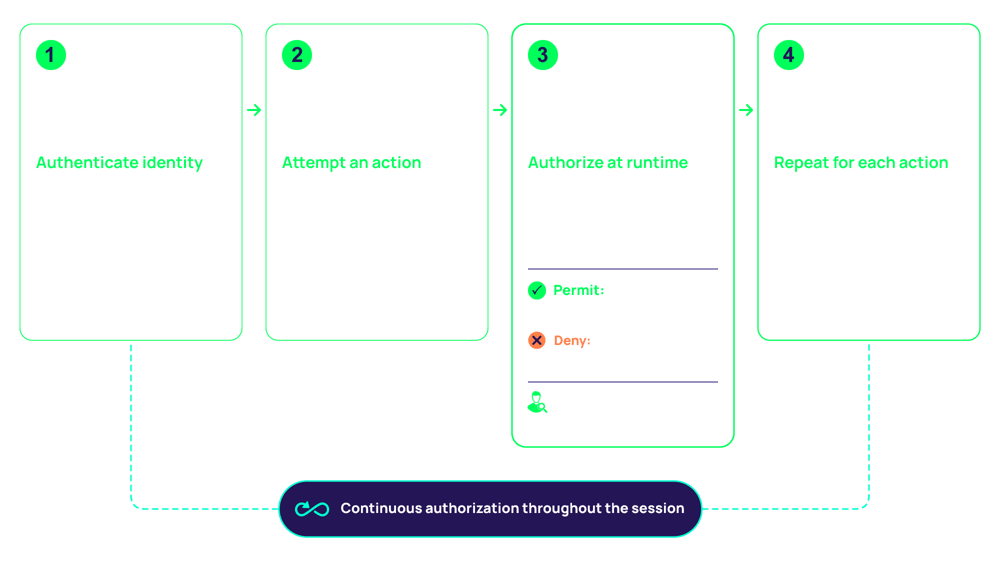
Traditional access control methods authorize an identity once, at login, then treat that decision as valid for the rest of a session. Runtime authorization, by contrast, authorizes an action at the moment it's attempted by an identity, based on administratively defined policies and real-time contextual information.
Enterprises usually institute runtime authorization as part of a broader continuous authorization model, in which actions are authorized throughout the duration of a session.
Runtime authorization typically takes four elements into account:
1.Principal. The human, machine, service account, workload or AI agent attempting an action.
2.Action. What the identity is trying to do, such as connect to a server, execute a database query, call an API, invoke an AI tool or run a command.
3.Resource. What the identity is trying to access, such as a database, server, application, cloud resource, Kubernetes cluster or API.
4.Context. Situational information available at the moment the action is attempted, such as device posture, location, time of day, resource sensitivity and session risk signals.
A typical runtime authorization flow follows a multistep process:
Step 1. A principal attempting to access an enterprise resource proves its identity using an authentication method or protocol, such as a password, certificate, API key, SSH key or OAuth token.
Step 2. The authenticated principal attempts to perform an action against an enterprise resource.
Step 3. The authorization system evaluates the attempted action against policy, using live contextual data to permit or deny the action. Either outcome is logged to an audit trail tied to the principal that attempted it.
Step 4. Steps 2 and 3 repeat for each subsequent action the principal attempts, for as long as the session persists.
Related security concepts
Runtime authorization overlaps with or complements numerous other cybersecurity disciplines and solutions.
Concept/capability |
Function |
How it relates to runtime authorization |
Application access governance (AAG) |
Governs entitlements and segregation of duties within business applications such as ERP and financial systems. | Complements runtime authorization, which governs individual actions against infrastructure and data resources. |
Authentication |
Verifies that an identity is who or what it claims to be before granting it access to a system. | Runtime authorization builds on authentication by evaluating what an already authenticated identity is permitted to do. |
Continuous authorization |
Injects credentials at the connection point so an identity never directly holds or views the underlying secret. | Continuous authorization is the operational model in which runtime authorization is typically employed. |
Credential brokering |
Assigns permissions to groups of users rather than individuals. | Credential brokering protects against credential theft. Runtime authorization protects against misuse of access itself, so even a properly authenticated identity cannot perform an unauthorized action. |
Identity security |
Discovers, governs and protects AI, human and machine identities across the enterprise. | Identity security is the broader discipline runtime authorization operates within. |
Just-in-time access |
Grants identities privileged access to systems and resources only at the moment it is needed, scoped to the resources and permissions a task is expected to require, for a defined period of time. | Just-in-time access governs when privileged access is granted, while runtime authorization governs what an identity is permitted to do for as long as that session remains active. |
Least privilege(aka principle of least privilege) |
Grants identities only the minimum set of privileges necessary to perform their task. | Runtime authorization enforces least privilege continuously, evaluating each action against current policy rather than relying on a static role assignment. |
NHI security |
Discovers, governs and protects the identities assigned to machines, applications, services and scripts across the enterprise. | NHI security discovers and governs NHIs across their lifecycle, while runtime authorization governs what those identities are permitted to do once access is granted. |
Privileged Access Management (PAM) |
Secures privileged accounts, credentials and administrative sessions, typically through vaulting, rotation and credential brokering. | Runtime authorization extends PAM beyond vaulting, credential brokering and session monitoring, authorizing individual actions within a session. |
Zero standing privilege (ZSP) |
Ensures identities are never granted permanent privileged access to critical enterprise resources. | Runtime authorization supports zero standing privilege by evaluating and permitting each action as it is attempted, rather than granting persistent access. |
Zero trust |
Assumes no identity or device is trustworthy by default and requires continuous verification before granting access. | Runtime authorization extends zero trust principles to the individual action within an active session. |