-
Accelerate AI SecurelyEnable secure AI adoption with visibility, governance, and control across identities, agents, and accessDefend Against AI AttacksProtect your organization from AI-driven threats by securing identities, controlling access, and reducing attack paths.Cyber InsuranceImprove your cyber insurance readiness with stronger identity security, governance, and privileged access controls.RansomwareDefend against ransomware by securing privileged identities, limiting access, and reducing attack paths.Vendor ConsolidationReduce complexity, strengthen security and improve IT ROI through platform consolidation.Secure Remote WorkforceSecure access for employees, contractors, and third parties from anywhere.Reduce Identity RiskGain visibility, control, and continuous authorization across every identity.Financial ServicesReduce identity risk and strengthen governance across financial institutions.HealthcareSecure access to critical systems, patient data, and clinical environments.Federal & PublicSupport secure access, compliance, and operational resilience across public sector enterprises.Energies & Critical InfrastructureProtect critical systems and privileged access across essential infrastructure.EducationProtect your educational institution from ransomware and data misuse.VisibilityDiscover every human, machine, and AI identity across your environment.PostureIdentify excessive privileges, policy gaps, and emerging identity risks.ControlApply authorization and access policies to every identity, session, and action.Human IdentitiesSecure workforce, privileged, and third-party identities.Machine IdentitiesProtect secrets, credentials, certificates, and non-human identities.Agentic IdentitiesGovern and control access for AI agents and autonomous systems.Cloud StatusCheck availability and service health across Delinea cloud services.Customer SupportGet product support, technical guidance, and help from Delinea experts.Identity Security Maturity ModelAssess your identity security maturity and identify priorities for improvement.Professional ServicesAccelerate deployment, adoption, and value with expert implementation and advisory services.Trust CenterAccess Delinea security, privacy, compliance, and assurance information.User TrainingBuild product knowledge and skills with Delinea training and learning resources.
-
The Delinea PlatformA unified identity security platform that protects human, machine and AI identities across your enterprise.Delinea Iris AIAI-powered intelligence that delivers real-time insights, automation and continuous authorization.Secret ServerSecure privileged credentials with enterprise password vaulting and session management.Continuous Identity DiscoveryContinuously discover and inventory every identity across your enterprise.Credential ManagerManage, rotate and protect privileged credentials across hybrid and cloud environments.Fastpath Access GovernanceAutomate access governance, segregation of duties and compliance reporting.Privilege Control for ServersEnforce least privilege and application control across Windows and Linux servers.Privileged Remote AccessProvide secure remote access for employees and third parties without exposing privileged credentialsFull Product ListingBrowse the complete Delinea product portfolio and find the right solution for your enterprise.Why Delinea FastpathDiscover how Delinea Fastpath helps enterprises govern access, reduce risk and strengthen compliance across critical business applications.Delinea Fastpath Access ControlIdentify Segregation of Duties conflicts and sensitive access risk within and across business applications.Delinea Fastpath Access ReviewAutomate user access reviews and generate clear, consistent audit evidence with less manual effort.Delinea Fastpath Change TrackingMonitor critical permission, configuration and data changes across business applications.Delinea Fastpath Access ProvisioningAutomate compliant access requests, approvals, provisioning and deprovisioning.Delinea vs CyberArkCompare Delinea and CyberArk to see how the platforms differ in identity security, deployment and ease of use.Delinea vs BeyondTrustExplore the key differences between Delinea and BeyondTrust across privileged access and identity security.Delinea vs MicrosoftSee how Delinea extends beyond native Microsoft capabilities to deliver comprehensive identity security.Delinea vs One IdentitySee how Delinea authorizes every action at runtime, keeps credentials off users and AI agents and supports your identity provider.Delinea vs SaviyntExplore how Delinea and Saviynt compare across identity security, governance and privileged access.
-
All ResourcesBrowse Delinea’s complete library of educational content and resources.BlogsStay up to date with the latest identity security insights and industry trends.VideosWatch product demonstrations, customer stories and educational content.WebinarsJoin expert-led webinars covering identity security and best practices.EventsDiscover upcoming conferences, webinars and Delinea events.EbooksDownload in-depth guides, research and educational resources.GlossaryUnderstand key identity security, cybersecurity, and privileged access terms with Delinea’s comprehensive glossary.PodcastEnjoy freshly brewed hot takes with our Grounds for Access podcast.Product DocumentationAccess technical guides, product documentation, and implementation resources.Solution BriefsLearn how Delinea solutions address specific business and security challenges.Trust CenterReview security, compliance, privacy, and trust-related information.
-
Customer SuccessMaximize the value of your Delinea investment with expert guidance and ongoing success planning.Professional ServicesAccelerate deployment and optimize your identity security strategy with Delinea experts.User TrainingBuild product knowledge and develop expertise through Delinea training and certification programs.Cloud StatusView the real-time status and availability of Delinea cloud services.Customer CommunityConnect with peers, share knowledge and discover best practices from the Delinea community.Integrations MarketplaceExplore integrations that extend and enhance the Delinea Platform across your technology ecosystem.Product DocumentationAccess technical documentation, product guides, APIs and implementation resources.Technical SupportGet expert assistance, troubleshoot issues and manage support requests.Trust CenterReview Delinea’s security, compliance, privacy and trust information.
-
About DelineaLearn about Delinea’s mission, vision, and approach to identity security.The Delinea DifferenceDiscover what sets Delinea apart in securing human, machine, and AI identities.Leadership TeamMeet the leaders driving Delinea’s strategy and innovation.Contact UsConnect with our teams around the world.
What is zero trust?
Why zero trust matters
 Traditional perimeter-based enterprise security architectures were designed to protect conventional on-premise IT infrastructure and to defend trusted corporate network borders. Today, businesses routinely deploy applications in the cloud, beyond the secure confines of the enterprise network. And users access applications and SaaS solutions from any place, using both company-supplied and personal devices, often bypassing the trusted enterprise network altogether.
Identity has emerged as a primary attack vector. Threat actors routinely target identities to steal credentials, using them to log in as legitimate users, traverse networks, exfiltrate data and carry out further attacks.
Credential abuse plays a role in 39% of breaches, according to a Verizon 2026 Data Breach Investigations Report. And according to IBM’s 2026 Cost of a Data Breach Report, it takes an average of 247 days to identify and contain these types of breaches.
A 2025 cyberattack on British retailer Marks & Spencer shows how identity-based attacks can quickly escalate into major business disruptions. Threat actors used social engineering techniques to gain access to a legitimate account and spread ransomware across the retailer's IT estate. The attack disrupted operations for weeks, shut down online shopping and cost the company an estimated £300 million or over 30% of its annual operating profit.
Zero trust reduces the blast radius
Zero trust takes an identity-centric, location-independent approach to cybersecurity, replacing implicit trust with continuous, policy-based authorization. It enforces the principle of least privilege access, helping reduce credential theft and abuse risks, restrict lateral movement and contain attacks.
Zero trust reduces the blast radius by limiting what attackers can do after gaining illicit access. It helps mitigate ransomware, credential-based and supply chain attacks by enforcing least privilege, continuously authorizing identities and restricting lateral movement. It also reduces the attack surface by eliminating unnecessary standing privileges, helping mitigate both insider threats and external attacks.
As an increasingly important business requirement, zero trust is not just a security best practice. Many government regulations and industry frameworks require or encourage zero trust principles. And cyber insurers increasingly require policyholders to implement zero trust controls and also demonstrate proof of compliance as a condition of coverage.
Zero trust is central to agentic AI security
Zero trust was originally applied to network security and human user access, but in today’s enterprises, non-human identities (NHIs) including AI agents far outnumber their human counterparts.
Most AI agents operate outside established identity and access controls, with no authorization enforcement and no audit trail. They typically inherit the access rights of whoever deployed them, whether that's a person's own credentials or a shared service account. Often those accounts carrying far more privileges than the task requires. Because agents are built to complete a goal, they will work to complete it, finding ways to obtain elevated privileges if that's what the task demands. Worse still, AI agents operate at machine speed, making it difficult for security teams to identify and mitigate threats before they spread across the enterprise.
In a 2026 IBM Institute for Business Value report, 77% of CIOs and CTOs said AI adoption is outpacing their current governance capabilities. According to a 2026 Delinea Identity Security report, 80% of organizations cannot always explain why an NHI took a privileged action.
Zero trust principles provide the governance framework needed to secure agentic AI deployments by removing standing privileges and continuously authorizing AI agents at runtime based on policies and live contextual data.
Zero trust versus traditional perimeter security
|
Traditional security |
Zero trust |
|
Trust based on network location |
Trust based on verified identity and context |
|
One-time authentication |
Strong authentication and continuous authorization |
|
Broad, standing access |
|
|
Perimeter-focused security |
Identity-centric security |
|
Static access policies |
Dynamic, risk-based authorization |
|
Assumes users inside the network are trusted |
Assumes no user, device or application is inherently trusted |
-
The core principles of zero trust
Although implementations vary, most zero- trust architectures are built on three fundamental principles. -
Verify explicitly
Every request for access is evaluated individually based on policy and contextual data. No user or application is trusted simply because it has previously authenticated or resides inside the corporate network.
-
Enforce least privilege
Every identity is granted the narrowest set of permissions needed. Broad, standing access rights are replaced with time-limited, task-scoped grants that automatically expire when the work is done.
-
Assume breach
Zero trust assumes attackers will eventually gain an initial foothold somewhere in an environment. Zero trust security controls are designed to limit lateral movement, reduce the blast radius of compromised credentials and contain attacks before they spread throughout the enterprise.
How zero trust works
Zero trust shifts security from a location-based model to an identity-centric one. Rather than granting access based on where a request originates, zero trust evaluates every request on its own merits. This identity-centric approach aligns with the principles of NIST Special Publication (SP) 800-207, one of the industry's most widely recognized zero trust frameworks.
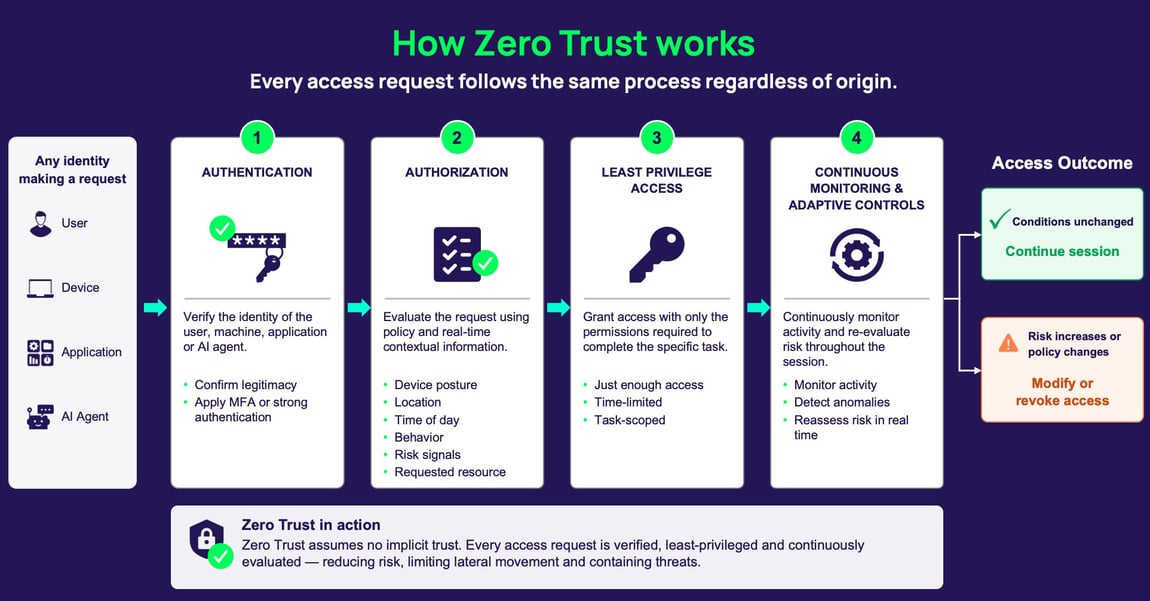
Zero trust is not a single technology or solution. It is an operational model that verifies identities, continuously assesses risk and authorizes access to enterprise resources and data. Every access request follows the same basic process.
Authentication. Every request begins by verifying the identity of the user, machine or AI agent requesting access. Authentication confirms that the identity is legitimate before additional policy decisions are made.
Authorization. Zero trust analyzes contextual data such as device posture, user location, time of day and behavioral patterns to determine whether the action can be executed.
Least privilege access. Once trust has been established, access is granted according to the principle of least privilege (PoLP). Identities receive only the permissions required to perform a specific task.
Continuous monitoring and adaptive controls. Authorization does not end after login. Identity activity, device posture and contextual risk continue to be evaluated throughout the session. If conditions change, access policies can be adjusted automatically to reduce risk.
Zero trust building blocks
Zero trust is implemented through a combination of complementary security principles, governance practices and technologies. While each serves a distinct purpose, together they help continuously authorize identities, enforce least privilege and protect critical resources. Zero trust is typically implemented incrementally, beginning with core identity security functionality.
Capability |
Function |
How it relates to zero trust |
Identity security |
Discovers, governs and protects AI agents, humans and machine identities across the enterprise. | Identity is the foundation of zero trust. Every access decision begins by verifying the identity requesting access. |
Least privilege access |
Limits access to the minimum permissions required to perform authorized tasks. | Least privilege is a core zero trust principle that minimizes the impact of compromised accounts and credentials. |
Just-in-time (JIT) access |
Grants elevated privileges only when needed and automatically revokes them when the task is complete. | Supports zero trust by eliminating unnecessary standing privileges and reducing the attack surface. |
Zero standing privilege (ZSP) |
Eliminates permanent privileged access by requiring every privileged request to be explicitly approved and time-limited. | Extends zero trust by ensuring privileged access is continuously evaluated rather than permanently assigned. |
Privileged Access Management (PAM) |
Secures privileged accounts, credentials and administrative sessions. | PAM provides many of the controls used to implement zero trust for privileged users and administrators. |
Zero trust network access (ZTNA) |
Provides secure, application-level access based on verified identity, device posture and organizational policies instead of network location. | ZTNA applies zero trust principles to network access, replacing implicit network trust with continuous authorization. |