
What is Just-in-Time access

Just-in-time (JIT) access is an identity security capability that grants users, machines, AI agents and automated processes privileged access to systems and resources only when needed, scoped to the specific task.  It replaces standing privileges with time-bound grants, automatically revoking privileges when the time window closes, reducing the attack surface and lowering credential theft and abuse risks.
delinea-photo-stopwatch

Why just-in-time access matters

Many organizations use Privileged Access Management (PAM) solutions to control and audit privileged access to critical systems and resources. PAM solutions strengthen access security by vaulting credentials, enforcing rotation schedules and logging session events. These are essential capabilities. But traditional PAM solutions weren't designed to manage how long access persists after the original need has passed. 

Standing privileges increase risk 

Most organizations grant privileged access for a specific task or project, with the expectation that it will be reviewed and removed when the work is done. That cleanup rarely happens on time, or at all.  

A developer joins the team and gets a role that includes access to a database, a production server, or maybe a Kubernetes cluster. The work that required all that access wraps up in the first week, but the privileged account stays active long after anyone needs it. 

Privilege creep expands the attack surface 

Over time, these permissions accumulate. Users change roles, projects end, and responsibilities shift, but access often remains in place. 

Privilege creep and standing privileges open the door for threat actors. Attackers can exploit stale credentials and over-permissioned accounts to penetrate systems, disrupt critical applications and services, and steal confidential data. Credential abuse accounts for 39% of breaches, according to Verizon's 2026 Data Breach Investigations Report. And according to IBM's 2025 Cost of a Data Breach Report, it takes an average of 246 days to identify and contain these types of breaches. 

The problem is about to get a lot worse with AI. The latest AI-driven tools can exploit standing privileges and traverse networks up to 47 times faster  than human operators, according to the SANS Institute. And emerging frontier AI LLMs like Claude Mythos will enable threat actors to uncover vulnerabilities and carry out far more sophisticated attacks at even greater speed. 

JIT access continuously enforces least privilege 

Just-in-time access helps organizations eliminate standing privileges and avoid privilege creep. Rather than granting access that persists until someone removes it, JIT access provisions it for exactly as long as a task requires, then revokes it automatically when that window closes. The developer who needs database access for a deployment gets it for two hours. The contractor brought in for a maintenance window gets it for the duration of that window. When the work is done, the access is automatically revoked. 

JIT access extends PAM with adaptive authorization 

JIT access doesn't replace PAM; it extends it. PAM controls how privileged accounts are managed and how credentials are stored and rotated.  JIT access introduces the time dimension and continuously re-evaluates that authorization throughout every active session, not just at the moment access is approved. If context changes during a session, access can be terminated immediately. Together, PAM and JIT access enforce the principle of least privilege (PoLP) continuously, so every identity holds only the access permissions it needs, for only as long as it needs them. 

JIT access limits the impact of compromised credentials 

Even well-designed security programs can be breached. If an attacker does obtain valid credentials, JIT access limits what they can do with them. The access window is short, the session is logged in full, and continuous policy enforcement means a suspicious pattern can trigger termination of the session before significant damage is done. Modern JIT access solutions provide additional protection against credential theft by acting as a proxy between the user and the resource, injecting credentials directly into the session so the user never handles the underlying password or key. 


How just-in-time access works 

Just-in-time access replaces standing privileges with an automated process that continuously authorizes users throughout the life of a session based on policy. Here's what that looks like in practice.
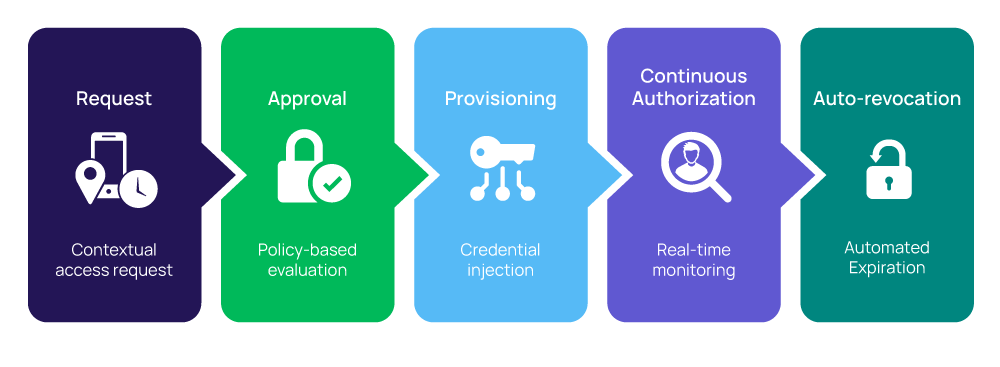
delinea-diagram-jit-access-five-step-flow-web

Step 1: The request 

A user, service account, AI agent or automated process submits a request for access to a specific resource, with context: what they need, how long, and why. Modern JIT implementations route these requests through collaboration, and ITSM tools teams already use like Slack, Microsoft Teams, Jira and ServiceNow to avoid friction and remove adoption barriers. 

Step 2: Access approval 

The request is evaluated against a predefined policy. Low-risk requests to non-sensitive systems might be approved automatically, while still generating a full audit trail. Higher-risk requests, such as write access to a production database or administrative access to an identity system, might be routed to a human approver or require multi-party authorization. Policy can factor in the requester's role, the sensitivity of the resource, the device making the request, and other contextual signals. 

Step 3: Provisioning  

Once approved, access is provisioned. In contemporary JIT systems, the user never sees the underlying credential. The access layer retrieves or generates the necessary credentials from a vault, injects them directly into the session, and connects the user to the resource. The credential exists, but the user never handles it directly, which eliminates a common source of credential exposure. When the session ends, the credential is automatically rotated in the vault, so even if it's intercepted during the session, it can't be reused.  

Step 4: Continuous authorization  

Granting access is not the end of the authorization story. In well-designed JIT implementations, policy continues to be evaluated throughout the active session, not just at the moment access was approved. If context changes during a session, such as a policy update, a device posture change, or a security event, the system can terminate the session immediately rather than waiting for the time window to expire.  

Step 5: Automatic revocation 

When the approved time window closes, access is automatically revoked. The session ends. The credential is invalidated or rotated. There's no manual cleanup step, no ticket to close, no checklist item someone might forget. If the user still needs access, they submit a new request, which creates a new audit record. 

Types of just-in-time access

Just-in-time access can be implemented in several ways. The three most common approaches are justification-based access, ephemeral accounts and
privilege elevation. Most organizations use a combination of these methods depending on the resource being accessed and the level of risk involved.

delinea-icon-conditional-access-teal
Justification-based access (sometimes called broker and remove) requires users to provide a reason for why they need access before it's granted. Once approved, they're connected to the resource for a limited period.  

delinea-icon-lifecycle-thumbprint-teal
Ephemeral accounts take a different approach. Rather than granting access to an existing privileged account, the system creates a temporary one-time account scoped to the task. Once the task is complete, the account is automatically disabled or deleted. This is sometimes referred to as ephemeral access. This approach is particularly useful for third-party and contractor access, where leaving a persistent identity in the environment creates unnecessary risk.

delinea-icon-privilege-elevation-teal
Privilege elevation grants a user a higher permission tier above their standard baseline role for the duration of a specific task, then returns them to standard access when the task is complete. Rather than creating a new account or connecting to an existing privileged one, the user's own account is temporarily elevated. This is common for end-user endpoint administration. For example, an employee might be granted temporary administrative privileges to install an application on their company-owned laptop.  

Related security concepts

Just-in-time access doesn't operate in isolation. It's one component of a broader identity security strategy.

Concept

Function

How it relates to JIT access

Privileged Access Management (PAM) 

Controls how privileged human and machine identities access sensitive systems, with credential vaulting, session management and audit.

JIT access extends PAM by adding the time dimension that traditional implementations lack, ensuring access granted through PAM controls doesn't accumulate into standing privileges.

 Zero trust

A security model built on the principle of never trust, always verify, where every access request is evaluated on its own merits.

JIT access supports zero trust by continuously authorizing users throughout the life of a session.

Zero standing privilege (ZSP)  

The principle that no identity, human or machine, should hold persistent privileged access to any system.

JIT access makes ZSP achievable, removing standing access continuously rather than through periodic cleanup.

How to implement just-in-time access
JIT access requires as much attention to process design as it does to technology selection.

Start with a standing access audit

Start with a standing access audit: Before configuring anything, understand what you are replacing. Identify which users, service accounts and automated processes hold standing privileged access to which systems. Prioritize by sensitivity. Production databases, identity administration systems and cloud management consoles are usually the right place to start.

Define policies before building workflows

Define policies before building workflows: Decide upfront what the default time window is for different resource tiers, what qualifies for auto-approval, what requires human review or multi-party sign-off and who the designated approvers are.  Implement granular policies that ask users to request and provide justification for why they need access to a system, resource, or tool.

Integrate request workflows into tools teams already use

Build approval workflows into Slack, Microsoft Teams, ServiceNow, Jira, or whatever your teams already use for collaboration and ticketing. If requesting requires a context switch into a separate portal, users will find workarounds.


Use auto-approval paths for low-risk resources

Not every access request requires a human approver. Low-risk requests to non-sensitive systems can follow automated approval paths that still generate a full audit record. Reserve human-in-the-loop approvals for sensitive systems where the review step is genuinely warranted.

Keep credentials in a centralized vault

Storing all privileged credentials in a centralized vault and rotating them automatically after each session is a foundational JIT access control. When credentials are managed and rotated in the vault, they remain unknown to the users who accessed them, even after the session ends.

Record and audit  all privileged access activity

Log every request, approval, session and revocation in a central location with enough context to support forensics and compliance audits.


Frequently Asked Questions

What is JIT access in cybersecurity?

Just-in-time access is a security model that gives human and non-human users the right access to the right resources for the right reasons at the right time. It helps eliminate standing privileges and privilege creep. Access is granted for a specific length of time for a specific purpose. Once the window closes, access is automatically and permanently revoked.

What problem does JIT access solve?

Threat actors routinely exploit standing privileges and excessive privileges to orchestrate attacks and exfiltrate data. JIT privileged access strengthens security by eliminating standing privileges and privilege creep and reducing credential theft and abuse risks. Users are granted temporary privileged access to certain systems and resources for a specific purpose for a set amount of time.

What is the difference between JIT access and permanent access?

Permanent access means a privileged account and its permissions remain active until someone explicitly removes them. Even if credentials are rotated regularly, the account and access rights still exist, creating an ongoing target for attackers. Just-in-time  access takes a different approach. Access is granted only when needed, for a specific task and a defined period of time, then revoked automatically. By eliminating persistent privileged access, JIT reduces the attack surface and limits the damage a compromised credential can cause.

What is the difference between JIT access and permanent access?

Permanent access means a privileged account and its permissions remain active until someone explicitly removes them. Even if credentials are rotated regularly, the account and access rights still exist, creating an ongoing target for attackers. Just-in-time  access takes a different approach. Access is granted only when needed, for a specific task and a defined period of time, then revoked automatically. By eliminating persistent privileged access, JIT reduces the attack surface and limits the damage a compromised credential can cause.

What security threats can just-in-time access help prevent?

JIT access is particularly effective against threats that depend on standing or excessive privileges. Threat actors routinely use compromised credentials to penetrate networks and move laterally, exploiting over-permissioned accounts to disrupt critical services or exfiltrate confidential data. JIT access limits exposure, ensuring privileged accounts exist only for the duration of an approved task. 

How does JIT access work for remote employees?

In well-designed implementations, the workflows for on-site employees and remote employees are the same. Users request access via the collaboration and ITSM tools they already use like Slack, Microsoft Teams, Jira and ServiceNow. Access is provisioned and revoked automatically and transparently. 

Can JIT access be automated?

Yes. Most JIT access solutions support a mix of automated and human-in-the-loop approval processes. Automated approvals might be used for routine, low-risk requests where the resource is non-sensitive and the use case is well understood, like a developer requesting read access to a non-production database or a pipeline requesting access to a staging environment. Human-in-the-loop approvals are better suited for higher-risk requests, like administrative access to production systems or write access to databases containing confidential data.

What systems can be protected with JIT access?

You can use a JIT access solution to protect a wide range of resources including servers, databases, cloud consoles and infrastructure, Kubernetes clusters, internal applications and network devices. JIT access solutions govern human and non-human identities including developers, database administrators, cloud and DevOps teams, AI agents and automation tools.  

What should I look for in a just-in-time access solution?

Look for a solution that lets you integrate request and approval processing directly into the collaboration and ITSM tools your company already uses. Next, look for a solution that supports continuous authorization. Some solutions only authorize users once, upon initial access. Then, look for a solution that handles credential injection automatically and transparently, so users connect to resources without ever seeing or handling the underlying password or key. Next, make sure the solution covers non-human identities as well as human users and provides detailed audit trails. Finally, look for a solution that works with your existing vaults and identity providers. Together, these capabilities define what mature JIT security looks like in practice. 

How do you implement JIT access without disrupting productivity?

Take a phased approach, starting with the highest-risk standing access rather than trying to convert everything at once. Build auto-approval paths for low-risk, frequently requested resources so routine access doesn't slow anyone down. Reserve human-in-the-loop approvals for sensitive systems where the review step is genuinely warranted. Choose a solution that lets users request access from the collaboration and ITSM tools they already use, and that integrates with your existing vaults and identity providers so you're not rearchitecting your environment to make it work. Done well, most users experience JIT access as a minor change to how they request access, not a daily obstacle. 

What compliance frameworks benefit from JIT access control?

Major compliance frameworks like SOC 2, PCI DSS, HIPAA, NIST SP 800-53 and ISO 27001 all require some form of least privilege enforcement, access controls and audit evidence. The common thread is that auditors increasingly want proof that controls are operating continuously, not just during periodic reviews. JIT access satisfies that expectation by design. Every request, approval, session and revocation is logged automatically, with the context needed to demonstrate compliance without manual evidence gathering.

What business outcomes can organizations expect from implementing JIT access?

JIT access helps businesses reduce risk by removing standing privileges and reducing the attack surface. It helps enterprises improve business agility by giving privileged users and AI agents instant, secure access to the tools they need. It helps operations reduce cost and complexity by eliminating VPNs, bastions and point security tools. Plus, it helps organizations simplify compliance and improve readiness by increasing visibility and streamlining audit prep.

How does JIT access apply to AI agents?

AI agents create the same standing privilege problem as human users, but they can act much faster and at much greater scale. An agent with persistent access to a database, API or cloud service can become a significant risk if it's compromised, misconfigured, or behaves unexpectedly. JIT access limits that risk by granting access only when required and revoking it automatically when the task is complete. As AI agents become more capable, reducing standing access becomes increasingly important. Unlike human users, AI agents can access multiple systems simultaneously, invoke other agents, and execute complex workflows at machine speed. 

How does JIT access reduce risks associated with machine identities?

Machine identities, including service accounts, API keys, automation scripts and pipeline credentials, are one of the most prevalent sources of standing privilege. They're often granted broad access at setup, rarely reviewed and almost never revoked proactively. JIT access brings machine identities under the same policy framework as human users. Access is granted only when needed, scoped to a specific task and automatically revoked when that task is complete.

How does JIT access support DevOps and CI/CD pipelines?

CI/CD pipelines are a common source of overprivileged machine identities. A deployment job that needs production access for ten minutes often ends up using credentials that work indefinitely. JIT access changes that. The pipeline is granted only the access required for a specific run, for a limited time, then access is automatically revoked when the job is complete. Every deployment generates an audit record, giving security teams visibility into what the pipeline accessed, what actions it performed, and when.

What is the difference between just-in-time access and just-enough access?

Just-in-time access and just-enough access address the same underlying problem from two different angles. Just-in-time access controls the duration, meaning access is granted when  needed and revoked when it's not. Just-enough access controls the scope, meaning users get only the permissions a specific task requires, nothing more. The two concepts are complementary. Controlling how long someone has access without limiting what they can do with it leaves half the problem unsolved, and vice versa. Modern JIT access solutions deliver both, issuing just-in-time permissions that are scoped to what the task requires and revoked automatically when it's done. 

What are the benefits of JIT access?

JIT access delivers security benefits and operational benefits. On the security side, it eliminates standing privileges, shrinks the attack surface and limits the damage a compromised credential can cause. Operationally, it simplifies access governance by replacing manual provisioning and deprovisioning with automated workflows. It also reduces the overhead of access reviews and creates a complete audit trail that simplifies compliance evidence gathering.

How does JIT access support third-party and vendor access?

Third-party access is one of the highest-risk standing privilege scenarios most organizations face. Contractors and vendors are often granted access to a project or maintenance window and then forgotten. JIT access solves this by giving third parties time-bound, scoped access for the duration of the engagement. When the engagement ends, the access is revoked automatically, and no persistent identity remains in the environment.

How does JIT access reduce the risk of insider threats?

Insider threats depend on access that persists beyond its original purpose. An employee with standing access to a sensitive system has an ongoing opportunity to misuse it, whether intentionally or accidentally. JIT access reduces that window to the duration of an approved task. Access that expires automatically can't be abused after the fact.

Can JIT access solutions work with existing identity providers and vaults?

Yes. Modern JIT access solutions are designed to integrate with existing identity providers. The identity provider handles authentication and supplies the identity context the JIT access solution uses to evaluate requests against policy. Modern JIT access solutions are designed to protect and extend prior vault investments. They can retrieve and inject credentials directly from existing vaults.