-
Accelerate AI SecurelyEnable secure AI adoption with visibility, governance, and control across identities, agents, and accessDefend Against AI AttacksProtect your organization from AI-driven threats by securing identities, controlling access, and reducing attack paths.Cyber InsuranceImprove your cyber insurance readiness with stronger identity security, governance, and privileged access controls.RansomwareDefend against ransomware by securing privileged identities, limiting access, and reducing attack paths.Vendor ConsolidationReduce complexity, strengthen security and improve IT ROI through platform consolidation.Secure Remote WorkforceSecure access for employees, contractors, and third parties from anywhere.Reduce Identity RiskGain visibility, control, and continuous authorization across every identity.Financial ServicesReduce identity risk and strengthen governance across financial institutions.HealthcareSecure access to critical systems, patient data, and clinical environments.Federal & PublicSupport secure access, compliance, and operational resilience across public sector enterprises.Energies & Critical InfrastructureProtect critical systems and privileged access across essential infrastructure.EducationProtect your educational institution from ransomware and data misuse.VisibilityDiscover every human, machine, and AI identity across your environment.PostureIdentify excessive privileges, policy gaps, and emerging identity risks.ControlApply authorization and access policies to every identity, session, and action.Human IdentitiesSecure workforce, privileged, and third-party identities.Machine IdentitiesProtect secrets, credentials, certificates, and non-human identities.Agentic IdentitiesGovern and control access for AI agents and autonomous systems.Cloud StatusCheck availability and service health across Delinea cloud services.Customer SupportGet product support, technical guidance, and help from Delinea experts.Identity Security Maturity ModelAssess your identity security maturity and identify priorities for improvement.Professional ServicesAccelerate deployment, adoption, and value with expert implementation and advisory services.Trust CenterAccess Delinea security, privacy, compliance, and assurance information.User TrainingBuild product knowledge and skills with Delinea training and learning resources.
-
The Delinea PlatformA unified identity security platform that protects human, machine and AI identities across your enterprise.Delinea Iris AIAI-powered intelligence that delivers real-time insights, automation and continuous authorization.Secret ServerSecure privileged credentials with enterprise password vaulting and session management.Continuous Identity DiscoveryContinuously discover and inventory every identity across your enterprise.Credential ManagerManage, rotate and protect privileged credentials across hybrid and cloud environments.Fastpath Access GovernanceAutomate access governance, segregation of duties and compliance reporting.Privilege Control for ServersEnforce least privilege and application control across Windows and Linux servers.Privileged Remote AccessProvide secure remote access for employees and third parties without exposing privileged credentialsFull Product ListingBrowse the complete Delinea product portfolio and find the right solution for your enterprise.Why Delinea FastpathDiscover how Delinea Fastpath helps enterprises govern access, reduce risk and strengthen compliance across critical business applications.Delinea Fastpath Access ControlIdentify Segregation of Duties conflicts and sensitive access risk within and across business applications.Delinea Fastpath Access ReviewAutomate user access reviews and generate clear, consistent audit evidence with less manual effort.Delinea Fastpath Change TrackingMonitor critical permission, configuration and data changes across business applications.Delinea Fastpath Access ProvisioningAutomate compliant access requests, approvals, provisioning and deprovisioning.Delinea vs CyberArkCompare Delinea and CyberArk to see how the platforms differ in identity security, deployment and ease of use.Delinea vs BeyondTrustExplore the key differences between Delinea and BeyondTrust across privileged access and identity security.Delinea vs MicrosoftSee how Delinea extends beyond native Microsoft capabilities to deliver comprehensive identity security.Delinea vs One IdentitySee how Delinea authorizes every action at runtime, keeps credentials off users and AI agents and supports your identity provider.Delinea vs SaviyntExplore how Delinea and Saviynt compare across identity security, governance and privileged access.
-
All ResourcesBrowse Delinea’s complete library of educational content and resources.BlogsStay up to date with the latest identity security insights and industry trends.VideosWatch product demonstrations, customer stories and educational content.WebinarsJoin expert-led webinars covering identity security and best practices.EventsDiscover upcoming conferences, webinars and Delinea events.EbooksDownload in-depth guides, research and educational resources.GlossaryUnderstand key identity security, cybersecurity, and privileged access terms with Delinea’s comprehensive glossary.PodcastEnjoy freshly brewed hot takes with our Grounds for Access podcast.Product DocumentationAccess technical guides, product documentation, and implementation resources.Solution BriefsLearn how Delinea solutions address specific business and security challenges.Trust CenterReview security, compliance, privacy, and trust-related information.
-
Customer SuccessMaximize the value of your Delinea investment with expert guidance and ongoing success planning.Professional ServicesAccelerate deployment and optimize your identity security strategy with Delinea experts.User TrainingBuild product knowledge and develop expertise through Delinea training and certification programs.Cloud StatusView the real-time status and availability of Delinea cloud services.Customer CommunityConnect with peers, share knowledge and discover best practices from the Delinea community.Integrations MarketplaceExplore integrations that extend and enhance the Delinea Platform across your technology ecosystem.Product DocumentationAccess technical documentation, product guides, APIs and implementation resources.Technical SupportGet expert assistance, troubleshoot issues and manage support requests.Trust CenterReview Delinea’s security, compliance, privacy and trust information.
-
About DelineaLearn about Delinea’s mission, vision, and approach to identity security.The Delinea DifferenceDiscover what sets Delinea apart in securing human, machine, and AI identities.Leadership TeamMeet the leaders driving Delinea’s strategy and innovation.Contact UsConnect with our teams around the world.
What is zero standing privilege?
Why zero standing privilege matters
 Standing privileges are a significant source of exposure for most enterprises. Threat actors frequently gain illicit access to privileged accounts using stolen credentials or other techniques. Once they gain a foothold, they move laterally, using privileged access to steal data, disrupt business-critical applications and services, and spread ransomware.
The MITRE ATT&CK framework documents how attackers consistently leverage compromised credentials to gain privileged access to sensitive systems and traverse networks. And the 2025 OWASP Non-Human Identities Top 10 identifies overprivileged machine identities as a prominent risk.
According to a 2026 Delinea Identity Security Report, 73% of decision-makers agree that standing access for non-human identities (NHIs) and AI agents increases risk. Yet 74% say standing access for NHIs and AI agents is necessary to meet uptime expectations. And 68% say security teams often accept standing access for NHIs and AI agents under operational pressure.
A 2024 Snowflake data breach demonstrates exactly what can happen when privileged access is permanently granted. In this widely publicized attack, threat actors used stolen credentials, some dating back to 2020, to access the production environments of over 150 Snowflake customers. No MFA was required. The permissions associated with those accounts granted attackers unrestricted access to confidential data.
-
Standing access creates permanent exposure
Every identity with persistent, privileged access is a standing target. The credentials don't have to be actively in use for the risk to exist. A dormant service account, a CI/CD pipeline running on long-lived credentials or an AI agent granted broad permissions during deployment can all become entry points for an attacker.
According to the 2026 Delinea Identity Security Report, organizations are more than twice as likely to grant NHIs and AI agents long-lived credentials as they are to use just-in-time authorization. Only 8% of respondents said they use ephemeral credentials. -
Zero standing privilege is essential for agentic AI security
ZSP was originally applied to human administrators, but the most urgent need today is for AI agents. Unlike traditional automation scripts, which execute pre-programmed steps, AI agents can make contextual decisions at runtime. They can determine which systems to interact with, request additional access, invoke new tools and trigger privilege changes on their own. A single agent with standing privileges can move across multiple systems at machine speed, spreading damage far faster than security teams can detect and mitigate.
-
ZSP complements least privilege
Least privilege defines how much access an identity should have, while zero standing privilege adds a time dimension. An identity can hold a minimal set of permissions and still pose a risk if those permissions are always available. ZSP reduces that risk by requiring that access not persist indefinitely.
-
Zero standing privilege reduces the blast radius of a breach
No security program can completely eliminate credential theft and abuse. Users can still fall for clever phishing attacks. And disgruntled employees can still share credentials with threat actors.
Zero standing privilege limits what an attacker can do with a compromised credential once they have it. It reduces the blast radius, limiting a threat actor's ability to move laterally and expand the scope of an attack. When an account holds no standing privileges, a stolen credential is of limited value.
How zero standing privilege works
How does zero standing privilege change the way organizations approach privileged access control? Quite simply, ZSP eliminates persistent privileges. Rather than assigning administrative permissions that remain available indefinitely, privileged access is granted only when there is a legitimate business need and revoked when that need no longer exists. In practice, most organizations operationalize ZSP using just-in-time access (JIT) solutions.
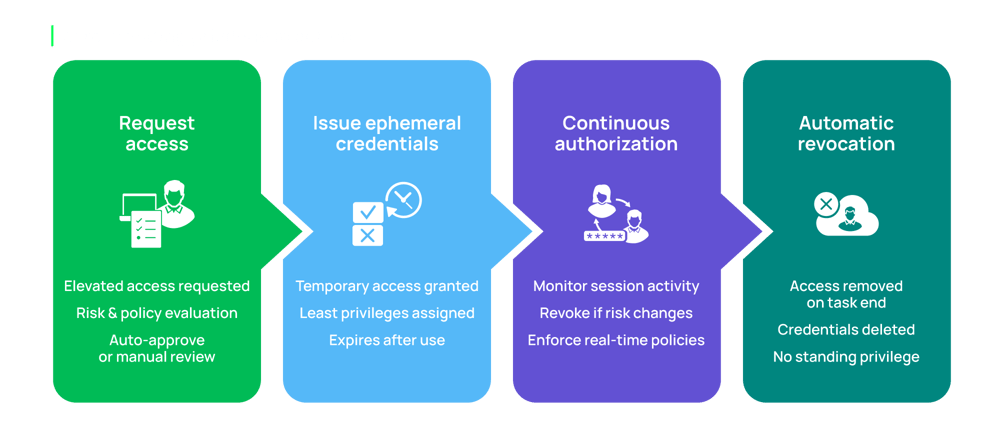
Elevating privileges with just-in-time access
With just-in-time access, humans, machines and AI agents are granted privileged access to systems and resources only when needed, scoped to the specific task, for a defined period. When an identity needs elevated privileges, it submits a request and justification through an automated workflow. The request is evaluated against a predefined policy. A low-risk request might be approved automatically, while a high-risk request might be routed to a person for approval. Once approved, an ephemeral credential is issued for the life of the session. The identity receives only the permissions necessary to complete the approved task and nothing more.
Continuous authorization
In well-designed JIT implementations, policy is continually evaluated throughout the active session. If context changes during a session, such as a policy update, a change in device posture , or a security event, the session can be terminated immediately.
Revoking access automatically
When the approved task is complete or the authorized time window expires, privileged access is removed automatically and the credential is destroyed. The identity returns to its normal operating permissions, leaving no standing privileged access available for an attacker to exploit. The next time elevated access is required, the evaluation process begins again.
Related security concepts
ZSP is a foundational principle that underpins many modern identity security solutions and practices, and complements other fundamental security principles.
Solution/concept |
Function |
How it relates to zero standing privilege |
Ephemeral credentials |
Short-lived credentials that exist only for the duration of a session. | Identity security solutions often use ephemeral credentials to enforce ZSP. |
Just-in-time (JIT) access |
An identity security capability that grants access only when needed and revokes it automatically when the access window expires. | JIT access is used to operationalize zero standing privilege. Privileged access is granted on demand for a defined window of time. |
Least privilege, or the principle of least privilege |
A foundational security concept that grants identities only the minimum set of privileges necessary to perform their task. | Least privilege defines the scope of access. ZSP ensures that access is not permanent. Least privilege defines the scope of access. ZSP ensures that access is not permanent. |
Privileged Access Management (PAM) |
A security discipline that governs, controls and audits privileged access to sensitive systems and resources. | PAM supplies the controls, credential vaulting and session management that make ZSP achievable. |
Zero trust |
A security model built on the principle of never trust always verify, where every access request is evaluated on its own merits. | Least privilege complements zero trust by defining what a verified identity is permitted to do once access has been granted. |
Zero standing privilege (ZSP) |
The principle that no identity, human or machine, should hold persistent privileged access to any system. | ZSP complements zero trust by ensuring that verified access is never permanent. |
Frequently Asked Questions