How has privileged access changed?
For years, securing a server meant securing the box. You bridged it to Active Directory, elevated privilege locally, recorded the session and kept the audit data on hand for the next compliance review. Server Suite did that job well, and it did it for some of the largest and most regulated environments in the world.
The job has changed.
Attackers don't just break into servers; they log in with stolen credentials
A valid login passes the checks a break-in would trip. Identity is now where risk concentrates. Audit is now something teams want to read in real time, not months after the fact. And multi-factor authentication (MFA), analytics and remote access that were once nice-to-have are now the baseline that auditors and cyber insurers expect.
The controls protecting privileged access kept moving. Many on-premise deployments did not. That gap, more than any single feature, is why Server Suite customers are moving to the Delinea Platform.
What Server Suite got right
Server Suite got the hard part right. The enforcement model it pioneered is still the right way to protect a server: consolidate identities through Active Directory and apply just-enough privilege on Linux and Windows. Customers built real discipline around it, and that work holds its value.
Moving to the platform doesn’t throw any of that away. The same enforcement model carries forward unchanged, and upgrading adds new capabilities on top of it.
Upgrading Sever Suite: an upgrade, not a rip-and-replace
The value here is clear: Server Suite deployments connect to the Delinea Platform in place, so the privilege enforcement running on your Linux and Windows estate stays exactly where it is. Nothing gets torn out.
That distinction matters because the objection we hear most is that modernizing sounds like a heavy lift. In practice, the enforcement that customers already trust stays put, and the capabilities come online without a forklift.
What you gain by upgrading Server Suite to the Delinea Platform
Once Server Suite connects to the platform, the day-to-day work of protecting privileged access gets easier:
-
One MFA policy, everywhere. Today, server MFA runs on its own dedicated infrastructure. On the platform, it’s one policy covering credential checkout and server login, with Okta, Duo, Ping and Entra ID all working natively.
-
Cloud audit, if you want it. Keep recordings on-premise, or move them to the cloud and stop babysitting SQL Server databases. Recordings from Server Suite, Secret Server and Privileged Remote Access land under one view, so the audit trail is in one place instead of scattered across systems.
-
Audit that reads itself. Delinea Auditing powered by Iris AI turns a recorded session into a plain-language summary of what happened and flags the risky moments, so a reviewer sees the events that matter instead of scrubbing hours of footage.
-
VPN-less remote access. Vendors and admins reach systems through a browser, with no VPN and no standing access. File transfer and RDP or SSH run from a native client. Add Secret Server and the session launches from a credential they never see.
-
Vaulting for your server credentials. Local admin accounts, service accounts and SSH keys might be sitting in scripts and spreadsheets right now. Secret Server adds discovery, dependency-aware password rotation and a resilient on-premise replica of the cloud vault. The capability is waiting on the Delinea Platform when you want it.
One control plane for privileged access
Put those together, and the real shift is architectural. The platform is cloud-native, with contracted 99.995% uptime and zero-time upgrades. That means the controls keep getting better in the background instead of waiting for the next on-premise maintenance window. Customers stop maintaining privileged-access infrastructure and start consuming privileged-access capability.
That’s also where the roadmap lives. The analytics, the AI and continued investment all go into the platform. A deployment that stays on-premise doesn’t just miss the new features; it slowly drifts further from where the product and the threat model are heading.
The future of privileged access: machine identities and AI agents
Privileged access is no longer only about human admins and a fixed set of servers. Machine identities and AI agents now request privilege too, often faster than any manual review can keep up. The question is shifting from who has access to whether this specific action should be allowed. Answering that in real time takes a control plane built for it.
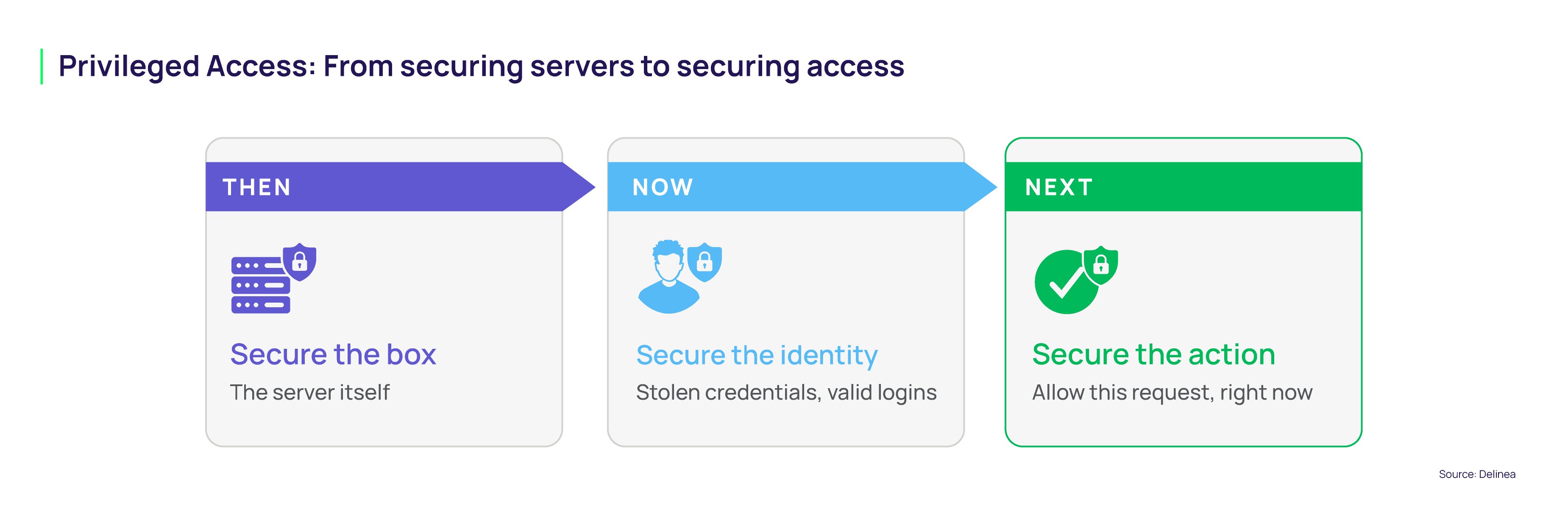
That is the arc Server Suite customers are stepping into. The move protects the enforcement they already rely on, retires the infrastructure they shouldn’t have to run and puts them on the product being built for what comes next. For customers who bet on us a decade ago, that feels less like a sales pitch and more like keeping a promise.

Delinea Platform Powered by Delinea Iris AI