What is identity security?

Identity security is the discipline of discovering, governing and protecting every human, machine and AI identity across an enterprise. It brings together identity governance, authentication, privileged access controls, continuous monitoring and threat detection to improve visibility, reduce risk, simplify compliance and increase operational efficiency.

Why identity security matters

delinea-photo-zero-standingIdentity has become the primary attack vector in contemporary cyberattacks. Threat actors routinely target identities, using stolen credentials and other techniques to breach systems, traverse networks, exfiltrate data and carry out attacks.

Credential abuse plays a role in 39% of breaches according to a Verizon 2026 Data Breach Investigations Report. And according to IBM’s 2025 Cost of a Data Breach Report it takes an average of 246 days to identify and contain these types of breaches. 

Identity sprawl undermines governance

Enterprises are managing more identities than ever before. Workers, developers, IT admins, contractors, machines, automation tools and AI agents all require secure access to enterprise systems, creating a complex, continuously changing identity ecosystem.

For most enterprises, the challenge is not simply the number of identities but the ability to govern them consistently. Today, many companies rely on a collection of independent identity and access management (IAM) solutions, privileged identity security tools and other security technologies to manage identities and control access to critical applications and services scattered across hybrid and multicloud environments. Over-permissioned accounts, standing privileges and visibility gaps are commonplace. In a 2026 Delinea Identity Security Report, 90% of decision-makers admitted to having at least some sort of identity visibility gap.

A 2025 cyberattack on British retailer Marks & Spencer shows how identity-based attacks can quickly escalate into major business disruptions. Attackers used social engineering ploys to gain illicit access to a legitimate account and spread ransomware across the retailer’s network. The attack, which disrupted operations for weeks and shut down online shopping, was estimated to cost the company approximately £300 million or about 31% of its annual operating profit.

AI agents expand the attack surface

AI agents introduce unprecedented security challenges. Unlike traditional machine identities, they can access multiple systems simultaneously, invoke other agents and execute complex workflows at machine speed. Unlike conventional scripted automation, agentic AI system behavior is non-deterministic, making it difficult to predict what resources agents will access or what actions they will perform.

Identity security helps organizations improve their overall security posture and reduce risk by providing full visibility and enforcing the principle of least privilege (PoLP) for every identity across the extended enterprise, including AI agents. The most effective identity security implementations continuously evaluate and authorize access based on policy and real-time contextual information.

  • Standing access creates permanent exposure

    Every identity with persistent, privileged access is a standing target. The credentials don't have to be actively in use for the risk to exist. A dormant service account, a CI/CD pipeline running on long-lived credentials or an AI agent granted broad permissions during deployment can all become entry points for an attacker.

    According to the
    2026 Delinea Identity Security Report, organizations are more than twice as likely to grant NHIs and AI agents long-lived credentials as they are to use just-in-time authorization. Only 8% of respondents said they use ephemeral credentials.

  • Zero standing privilege is essential for agentic AI security

    ZSP was originally applied to human administrators, but the most urgent need today is for AI agents. Unlike traditional automation scripts, which execute pre-programmed steps, AI agents can make contextual decisions at runtime. They can determine which systems to interact with, request additional access, invoke new tools and trigger privilege changes on their own. A single agent with standing privileges can move across multiple systems at machine speed, spreading damage far faster than security teams can detect and mitigate.

  • ZSP complements least privilege

    Least privilege defines how much access an identity should have, while zero standing privilege adds a time dimension. An identity can hold a minimal set of permissions and still pose a risk if those permissions are always available. ZSP reduces that risk by requiring that access not persist indefinitely.

  • Zero standing privilege reduces the blast radius of a breach

    No security program can completely eliminate credential theft and abuse. Users can still fall for clever phishing attacks. And disgruntled employees can still share credentials with threat actors. 

    Zero standing privilege limits what an attacker can do with a compromised credential once they have it. It reduces the blast radius, limiting a threat actor's ability to move laterally and expand the scope of an attack. When an account holds no standing privileges, a stolen credential is of limited value.  

How identity security works 

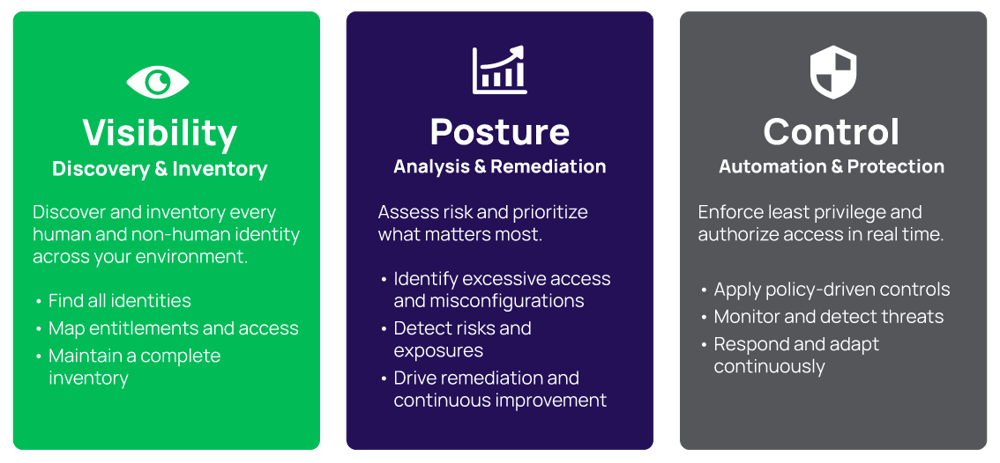
Identity security is an operational model built around three interconnected functions: visibility, posture and control. Visibility uncovers what identities exist, including privileged identities. Posture determines which of them carry the greatest risk. Control enforces what they're allowed to do.
 delinea-diagram-identity-security-3-pillars

Elevating privileges with just-in-time access

With  just-in-time access, humans, machines and AI agents are granted privileged access to systems and resources only when needed, scoped to the specific task, for a defined period. When an identity needs elevated privileges, it submits a request and justification through an automated workflow. The request is evaluated against a predefined policy. A low-risk request might be approved automatically, while a high-risk request might be routed to a person for approval. Once approved, an ephemeral credential is issued for the life of the session. The identity receives only the permissions necessary to complete the approved task and nothing more.

Continuous authorization

In well-designed JIT implementations, policy is continually evaluated throughout the active session. If context changes during a session, such as a policy update, a change in device posture , or a security event, the session can be terminated immediately. 

Revoking access automatically

When the approved task is complete or the authorized time window expires, privileged access is removed automatically and the credential is destroyed. The identity returns to its normal operating permissions, leaving no standing privileged access available for an attacker to exploit. The next time elevated access is required, the evaluation process begins again.


Identity security program components

Enterprises typically operationalize identity security using a mix of specialized components for managing identities across the IT estate. In the most effective programs, the components operate in a unified fashion.

Component

Function

Functional Pillar

Discovery and inventory tools

Continuously identifies, catalogs and maps every human and non-human identity, along with the permissions, relationships and resources associated with each identity across on-premise, cloud and SaaS environments. Visibility

Identity security posture management

Analyzes what identities do against what they're entitled to do, surfacing over-privileged, dormant and misconfigured accounts. Posture

Identity threat detection and response

Monitors identity behavior in real time looking for anomalous logins, credential stuffing, lateral movement and other suspicious activity. Posture

Just-in-time access

Grants access to a specific system or resource only for the time a task requires. Control

Privileged Access Management

Secures, monitors and controls access to sensitive accounts like admin, root and service accounts. Control

Secrets management

Secures, rotates and audits the API keys, tokens and certificates NHIs use to authenticate. Control

Identity governance and administration

Defines who should have access to what and manages that access through onboarding, role changes and offboarding. Control

Identity security and Privileged Access Management

PAM is a foundational component of most identity security programs. It protects the identities that present the greatest risk by vaulting privileged credentials, enforcing privileged session controls and maintaining audit trails for regulatory compliance and forensic investigations.

Identity security builds on that foundation. In addition to privileged identity management, it governs standard (non-privileged) user accounts and SaaS accounts, as well as AI agents and other NHIs across the enterprise. It also addresses broader challenges such as identity governance, posture assessment and threat detection.

delinea-photo-vault
delinea-photo-risk-login

Identity security and zero trust

Zero trust is a security model built on the principle of never trust always verify. With zero trust, every access request is evaluated on its own merits regardless of whether that request originates from inside or outside the enterprise.

Identity security supports zero trust by enforcing the principle of least privilege and granting access based on policy and real-time contextual information rather than relying solely on traditional authentication methods.

Identity security program best practices  

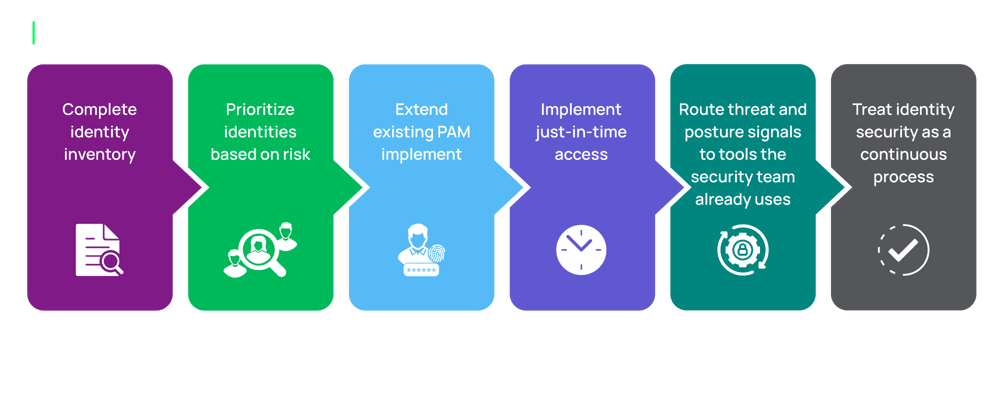
Building an effective identity security program is less about selecting individual technologies and more about introducing a consistent and cohesive operating model. Most organizations already have many of the required capabilities in place. The challenge is connecting them through a common framework that provides continuous visibility, posture assessment, and control for every identity across every environment.
 delinea-infographic-identity-security-flow-dark

  1. Start with a complete identity inventory

    Identity security begins with visibility. Use discovery and inventory tools to identify every identity across all your company’s on-premise infrastructure, cloud platforms and SaaS applications. Include human identities (workers, developers, IT admins, contractors and vendors) and non-human identities (machines, applications, service accounts and AI agents).
  2. Prioritize identities based on risk

    Not every identity needs the same level of scrutiny on day one. Start with privileged accounts, identities with access to confidential data and anything with standing access to production systems. Expand outward from there once the highest-risk population is under control.
  3. Extend your existing PAM implementation

    Use Privileged Access Management as the foundation for your identity security program. Extend the same policy-driven access controls used for privileged accounts to standard users, AI agents and other non-human identities.
  4. Implement just-in-time access

    Use JIT access to enforce the principle of least privilege and reduce credential theft and abuse risk. Replace standing privileges with time-bound grants scoped to specific tasks. Minimize the attack surface by automatically revoking privileges when the time window expires.
  5. Route threat and posture signals to tools your security team already uses

    Identity security posture management and identity threat detection become more valuable when they operate as part of existing security workflows. Accelerate threat detection and response by integrating identity risk signals into existing SIEM, SOAR and EDR systems.
  6. Treat identity security as a continuous process

    Identities and risks aren’t static. They evolve constantly as people change jobs, projects end and new applications are deployed. Treat visibility, posture assessment and control as an ongoing process, not a one-time event. Continuously discover identities and permissions. Continuously analyze and prioritize risk. Continuously adjust controls based on policy and real-time contextual data.


Frequently Asked Questions


General

What is the difference between identity security and identity and access management?

Identity security is a discipline that aims to discover, govern and safeguard all human and non-human identities across an extended enterprise. In practice, organizations operationalize identity security by implementing a mix of functional components including identity and access management (IAM) solutions. IAM solutions authenticate and authorize users and automate routine identity lifecycle management tasks like provisioning, modifying and removing accounts.

What's the difference between identity governance and administration and identity security posture management?

Identity governance and administration (IGA) and identity security posture management (ISPM) address different aspects of identity security. IGA determines who should have access to enterprise resources and manages that access throughout the identity lifecycle, including onboarding, role changes, access reviews and offboarding. ISPM assesses risk by identifying over-permissioned accounts, excessive standing privilege, stale entitlements and other exposure. Together, IGA and ISPM help ensure that identities receive appropriate access and that the access they've been granted doesn't create unnecessary risk.

How does identity security relate to zero trust?

Zero trust is a modern cybersecurity framework built on the idea of never trust, always verify. Unlike traditional security models that rely on perimeter defenses, zero trust emphasizes recurring validation of all users, devices and systems attempting to access resources. Identity security supports zero trust by continuously authorizing access based on policy and real-time contextual data.

What is a non-human identity?

A non-human identity (NHI) is any identity that isn't a person, including applications, service accounts, IoT devices, bots and AI agents. Each of these authenticates using credentials such as API keys, tokens or certificates, similar to how a person authenticates with a password. NHIs typically operate without the oversight applied to human users. In most enterprises they far outnumber human identities, making them a favorite target for threat actors.

How does identity security apply to AI agents?

AI agents operate autonomously and act at machine speed. They often inherit privileges from users or machine identities, increasing the risk of excessive permissions and unintended actions. Identity security reduces exposure by continuously discovering AI agents, assessing the risks they pose, and applying adaptive, policy-based controls to restrict access.

Does identity security replace Privileged Access Management ?

No. Identity security is a security principle. PAM is an identity security program component used to safeguard, control and track privileged access to critical enterprise resources. PAM solutions enforce the principle of least privilege, protect credentials in secure vaults and log privileged sessions to support compliance and forensics.

Implementation & operations

Where should an organization start with identity security?

Begin with visibility. Use discovery and inventory tools to catalog every human and non-human identity across your entire IT estate. Once identities have been discovered, you can assess their risk, prioritize the ones that matter most and start applying stronger controls. Starting with the highest-risk identities helps you demonstrate measurable risk reduction quickly and remove adoption barriers.

How do you build an identity security program when you already have PAM in place?

Start with the PAM solution you already have. Use it as the foundation for a broader identity security program instead of creating a separate initiative. Expand beyond privileged accounts, bringing standard users, machine identities, AI agents and SaaS accounts into the fold. Extend discovery to cover the entire population, then layer in posture management and threat detection to assess risk and enforce consistent controls across every identity, not just privileged ones.

How do you measure the success of an identity security program?

You can measure success by tracking how effectively the program enforces the principle of least privilege and reduces risk. Common metrics include the number of over-permissioned or dormant accounts remediated and the reduction in standing privileged access over time. Program leaders also track how quickly anomalous behavior is detected and contained, how rapidly unnecessary access is removed after role changes, and how often access reviews are completed. A successful program steadily reduces excessive permissions while allowing users, applications and AI agents to remain productive.

Risk & threat reduction

What are the most common identity-based attack techniques?

Common identity-centric adversary tactics and techniques include phishing, social engineering, credential stuffing, password spraying, token theft and malware designed to steal passwords or session cookies. Once attackers gain access, they often exploit over-permissioned accounts and standing privileges to move laterally, escalate privileges, access sensitive data, and deploy ransomware or other malicious payloads.

How does identity security reduce exposure to ransomware attacks?

Ransomware often spreads by exploiting accounts with excessive permissions. Identity security helps contain ransomware by enforcing the principle of least privilege. It limits the actions a compromised account can perform, reducing an attacker's ability to move laterally and exfiltrate or encrypt files. It may not fully prevent ransomware, but it can significantly limit its spread.

What is identity threat detection and response?

Identity threat detection and response (ITDR) is the practice of detecting, investigating and responding to attacks targeting digital identities. ITDR solutions continuously monitor identity activity for indicators of compromise such as unusual logins, impossible travel, privilege escalation, credential abuse and lateral movement. When suspicious behavior is detected, security teams can investigate the activity, and access can be automatically restricted or revoked to contain the threat before it spreads further.

Compliance & auditability

Does identity security help with regulatory compliance?

Yes. Many government and industry regulations like SOX, HIPAA, PCI DSS and NIST SP 800-53 require some form of least privilege enforcement and evidence of compliance. Securing identities helps by removing standing privileges, restricting unnecessary access, reducing the risk of unauthorized activity and providing auditors with clear evidence that access is appropriately controlled.

How does identity security help with attestation?

Auditors typically request evidence that users are granted appropriate access, that access is reviewed regularly and that unnecessary permissions are removed when they're no longer needed. Identity security discovery and inventory make it easy to provide proof of compliance. They provide a complete, up-to-date picture of which identities can access which critical resources.