The best security teams aren't just protecting the business anymore. They're enabling it.
That's a meaningful shift, and the CISOs who've made it will tell you it changes everything. How their teams operate. How they talk to the board. How quickly the business can move.
When your controls are intelligent, continuous, and built around what identities are actually doing, not just who they are, security stops being a cost center and starts being a genuine business accelerator. Getting there starts with one fundamental question: Do your controls stop at the front door, or do they travel everywhere your identities go?
When security works the way your business does
Today's enterprise moves fast. Developers spin up infrastructure on demand. AI agents execute tasks autonomously. Third parties access sensitive systems. Machine identities outnumber human ones. And every one of those identities, in every environment, at every moment, represents both an opportunity and a responsibility.
The organizations winning the security game right now are the ones who've built controls that match that pace. Not controls that slow teams down with manual approvals and access queues. Not static policies that have to be rewritten every time something changes. Controls that are dynamic, contextual, and intelligent, so your people can focus on innovation instead of administration.
That's the promise of granular, continuous authorization. And it's very much a reality today.
From Zero Standing Privilege to zero friction
One of the most powerful outcomes organizations experience when they implement Zero Standing Privilege is how quickly it reshapes the relationship between security and the rest of the business.
When access is just-in-time, scoped to the task, and automatically revoked the moment the session ends, something interesting happens. The attack surface shrinks dramatically. Long-lived credentials disappear. Over-provisioned identities become a thing of the past. And because access is granted in seconds rather than minutes, developers and operations teams stop looking for workarounds and start trusting the process.
Delinea customers see an 88% reduction in the overhead associated with provisioning and deprovisioning users
That's not just an efficiency win, it's a signal that the controls are working with the business, not against it. Every secret is vaulted. Every session is ephemeral. And your team spends their time on strategic security work, not access administration.
Continuous authorization: Control at the moment that actually matters
The real power of granular controls isn't just in how access is provisioned, it's in what happens during the session itself.
Delinea enforces intelligent, context-aware policy at the execution layer. Every command, every query, every configuration change is evaluated in real time against dynamic policies that account for who the identity is, what they're doing, and whether that action falls within acceptable parameters. When something's off, it's addressed immediately, before it becomes an incident, before your team sees a ticket, before any damage is done.
For your security team, this transforms the daily experience. Instead of triaging a flood of alerts and chasing down potential violations after the fact, they're operating proactively, backed by automation that handles enforcement and surfaces only what genuinely needs human attention.
The result is a 90% reduction in alert noise through AI-driven prioritization
Focused teams. Faster response. Cleaner outcomes.
And because every action by every identity is continuously authorized and audited in real time, you always know exactly what happened, why it was permitted, and what the outcome was. That's a fundamentally different level of clarity than most organizations have today.
Iris AI: Intelligence that explains itself
The most meaningful thing Delinea's Iris AI does isn't just making authorization smarter. It makes authorization explainable and, for security leaders accountable to boards, regulators, and audit committees, that distinction matters enormously.
Delinea Iris AI powers continuous authorization across every identity and every session. Risk scores are tied to observable, auditable evidence, not black-box outputs your team has to take on faith. When Delinea Iris AI flags an anomaly or recommends an action, your team understands exactly why, with the full context to make confident, defensible decisions.
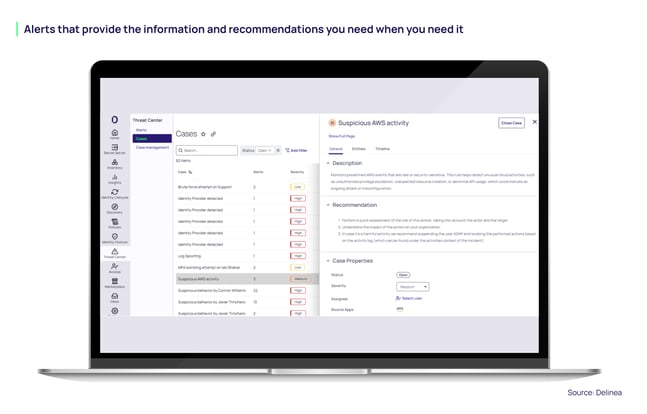
Predictive policy enforcement means generated alerts get smarter over time, reducing false positives, and ensuring your policies stay calibrated to actual risk rather than theoretical worst cases. No-code remediation means your team can act on those insights immediately, without waiting for engineering support.
And when a session requires deeper review, Delinea Iris AI narrates exactly what happened, turning what once took days of forensic log analysis into a clear, explainable story ready for your compliance team, your auditors, or your board.
Audit confidence, not audit anxiety
One of the most immediate and tangible benefits CISOs report after implementing continuous authorization is its impact on their compliance posture. Not just in theory, in practice, in the room, when the questions get hard.
Because every action by every identity is recorded, correlated, and reportable in real time, your organization is audit-ready in minutes, not weeks. The manual evidence gathering, the log pull requests, and the documentation scrambles that used to consume your team in the weeks before an assessment simply go away. Automated compliance reporting replaces all of it.
What that enables goes beyond efficiency. It changes how you show up in front of regulators and your board. Instead of presenting a retrospective picture of what you think happened, you're presenting a continuous, verifiable record of what actually happened, in every session, across every identity, across every environment. That kind of demonstrable control builds exactly the kind of trust that security leaders need to earn and keep.
The business case is the security case
Here's what the best CISOs have figured out: the business case for granular, continuous controls and the security case are one and the same.
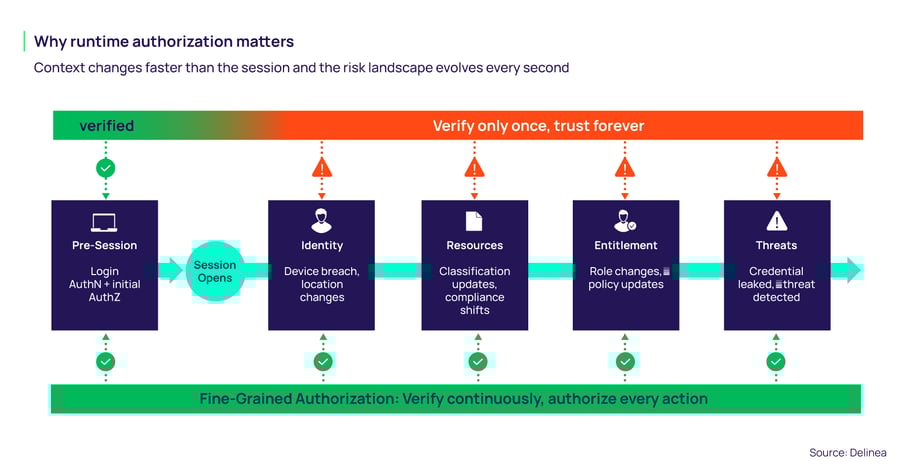 Fewer over-provisioned identities means a smaller attack surface and lower operational overhead. Just-in-time access means less credential exposure and faster access for the people who need it. Automated policy enforcement strengthens your compliance posture and reduces manual work for your team. Explainable AI-driven authorization means faster incident response and better board-level reporting.
Every outcome reinforces the others. And the compounding effect, across your security posture, your team's productivity, your compliance confidence, and your ability to support business growth, is what makes this approach genuinely transformational rather than just incrementally better.
Security that enforces itself, so your business keeps moving. That's not an aspiration. For organizations running the Delinea Platform, it's Tuesday.
The clarity every CISO deserves
You should be able to answer, clearly, confidently, and immediately, who has access right now, what they're doing with it, and exactly what actions every identity has taken across every session.
With Delinea's granular controls and Iris AI-powered continuous authorization, that clarity isn't aspirational. It's operational. And the security leaders who've built on it aren't just better protected; they're better positioned to lead, grow, and serve as the strategic partners their businesses need.
Control that enforces itself. Confidence that compounds. Security that accelerates everything it touches.