Identity Security Posture Management is growing up. Is it finally ready to answer the question: “How do we know our identity security work is focused in the right places?”
That question sounds simple, but it’s the difference between reporting activity and reporting outcomes. Boards don’t want to hear how many access reviews you ran or how many tickets your team closed. They want to know whether identity risk is going down, which risks are still being accepted, and what you’re doing next.
This is where Identity Security Posture Management (ISPM) comes into play. You can read all about ISPM here to get a good background: Using Identity Security Posture Management to measure and demonstrate risk reduction.
Today, we’re going to focus on how ISPM has evolved and how it works across a wide range of complex properties to quantify and reduce identity risk over time.
Blame it on the NHI—Non-human identities
What’s changed is the enterprise itself. Multi-cloud, SaaS sprawl, ephemeral workloads, API-first integration, and AI agents have multiplied the number of identities that can be abused. Non-human identities, a catchall that includes service accounts, API keys, bots, and really any other things “machine-related,” have grown exponentially.
Modern enterprises don’t have a single privileged plane anymore. Privilege now lives across identity providers, cloud consoles, SaaS admin panels, CI/CD pipelines, service principals, and automation roles. And, permissions change constantly, new cloud roles get created, OAuth apps get granted broad scopes and machine credentials proliferate.
Now, the risk is “do we even know which identities have effective admin access? And can that access be chained into something worse?”
From board questions to posture answers
ISPM expands your view across the full identity landscape—human and non-human—and turns that visibility into measurable, prioritized risk reduction you can report to leadership.
Security leaders keep getting asked variations of the same questions:
-
How do you know your identity security efforts are focused in the right places for maximum impact?
-
Do we understand our full identity attack surface—including non-human identities—and are we measurably reducing exposure over time?
What they need is a targeted understanding of identity risk exposure, shared metrics that align IT and security, and a path to close the gap between current posture and risk tolerance.
ISPM is built to produce data that technical teams and business leaders can align on: your current exposure, your risk tolerance, and where you should act next to close the gap.
This is also why ISPM is increasingly showing up in boardroom conversations. It gives security leaders a way to translate identity complexity—multiple platforms, messy entitlements, and constant drift—into a defensible risk narrative with trending metrics.
Maturing beyond visibility into validation
A modern enterprise can easily have thousands (or millions) of identities across Active Directory, Entra ID, Okta, and cloud providers. That number by itself isn’t actionable. Posture becomes actionable when it turns raw identity data into specific, validated risk findings, such as:
-
Authentication posture: Where MFA should be enforced but isn’t—especially for privileged access paths.
-
Credential posture: Where secrets are long-lived, not rotated, expiring unexpectedly, or scattered outside controlled systems.
-
Configuration posture: Where delegation, admin scoping, and policies create unintended privilege.
-
Access posture: Where people and workloads have more access than needed, or where standing permissions should be time-bound and constrained.
-
Delinea’s own ISPM framing aligns with this approach: running checks across identity environments for known risks like unvaulted admin accounts, privileged access without MFA, stale and orphaned accounts, and excessive standing permissions—and then using the gaps to quantify risk exposure and prioritize what to fix first.
This is the backdrop for ISPM’s evolution: it’s shifting from “identity posture = humans” to “identity posture = humans + machines + AI-enabled actors + their permissions + their relationships.”
ISPM is becoming the identity equivalent of cloud posture management
The direction of travel in the market is clear: ISPM is becoming the identity equivalent of cloud posture management—continuous assessment against identity risks, plus guidance to close the gaps.
Cleaning up stale access is now a top-tier identity risk reduction lever
Every environment has accounts that should no longer exist. Employees leave. Contractors roll off. Projects end. But access lingers—often in more than one identity system.
That lingering access becomes dangerous when it intersects with privilege. ISPM is evolving to prioritize stale access cleanup based on the access level and impact. A dormant user with basic app access is one thing. A dormant identity with administrative access—or the ability to self-escalate—is a different category of risk.
Posture management makes this visible, ranks it, and turns it into a remediation program you can execute and measure over time.
Seeing privilege paths across platforms is becoming a core ISPM capability
Enterprises rarely get compromised in a single system. Attacks traverse systems—especially where identity is federated.
A realistic example looks like this: compromise a standard user, leverage a misconfigured group membership or delegated permission to reach an administrative capability, pivot through federation into cloud roles, and then land on high-impact cloud permissions. The hard part is that each individual system might look “fine” when viewed in isolation. The risk emerges in the connections.
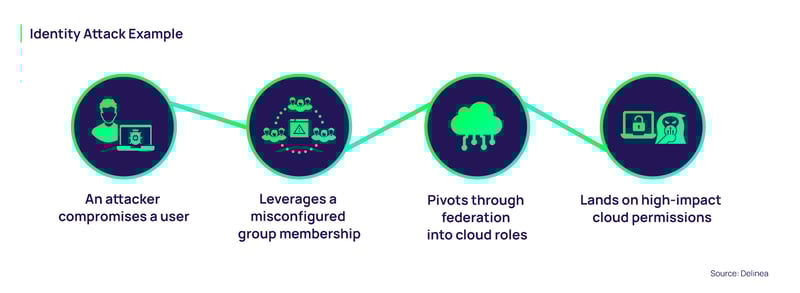
ISPM is evolving toward cross-platform privilege path visibility: the ability to identify “shadow admins” and indirect escalation routes across identity systems and cloud platforms, then give teams options—vault the account, restrict permissions, require step-up controls, enforce time-bound elevation, or accept and document the risk.
That last piece matters. Posture management isn’t just a hunt for “bad things.” It’s a system for making risk decisions visible and intentional, instead of accidental.
Risk prioritization is shifting from technical severity to business impact
Security teams don’t have a findings problem. They have a bandwidth problem. ISPM is evolving to rank identity risks based on impact, not just severity. A broadly permissive cloud role tied to production data should outrank a stale identity tied to a decommissioned app. Both matter; one matters now.
This is where ISPM becomes directly useful to Privileged Access Management (PAM) customers. Once you can see identity posture across platforms, you can identify quick wins that extend the value of your existing investment: privileged accounts that should be vaulted but aren’t, administrative roles that should be time-bound, policies that should be tightened, and stale privileged access that should be removed.
Where is ISPM headed next?
The next phase of ISPM is less about adding another dashboard and more about closing the loop between posture, authorization, and runtime reality.
The modern enterprise isn’t short on identity controls. It’s short on unified visibility, validated posture, and proof of risk reduction
ISPM is evolving to fill that gap—by discovering identities you didn’t know existed, showing how privilege actually works across your environment, and helping you prioritize and execute the actions that measurably reduce identity risk. For more information on how Delinea discovers identity risk, check us out here: Continuous Identity Discovery: Uncover Privileged Identities.