Improving security posture without causing friction is on the minds of every security leader.
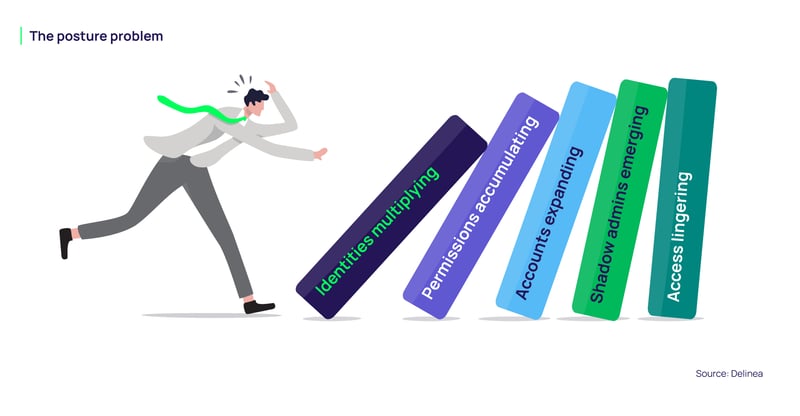
They want to do it, they need to do it, but they don't know how to do it. The challenge is understanding the risks that change by the minute. As organizations grow across cloud, SaaS, DevOps, on-premise, and AI-driven workloads, identities multiply faster than governance processes can keep up. Permissions accumulate over time, service accounts expand in scope, shadow admins emerge quietly, and stale access lingers long after it's no longer needed.
None of this feels urgent on its own. But together, it creates invisible exposure that compounds daily.
That's the posture problem.
The challenge isn't alerts. It's clarity and context.
CISOs and security leaders get a multitude of alerts indicating potential problems. In fact, they suffer from too many to manage. Without the context to know what truly matters, it causes chaos and wastes valuable time and energy.
You may know that standing privilege exists somewhere in your environment. You may suspect non-human identities are growing faster than you can find and govern them. You may have session logs for privileged activity that will be part of your audit that need to be reviewed.
But when leadership asks, "Where are we most exposed?" or "What should we fix first?” the answer is rarely simple.
Investigations become manual reconstruction projects. Audits turn into fire drills. Teams spend cycles debating severity scores instead of reducing exposure.
The simple fact is, attackers only need one overlooked privilege to move laterally
Posture isn’t just about having visibility. It’s about having confidence in knowing what risk exists and where you need to focus your attention.
Identity-centric risk, measured continuously
Delinea is built around a simple idea: risk should be measured through the lens of identity.
Delinea continuously monitors every identity, configuration, and interaction across your environment, human users, service accounts, workloads, and AI agents. It establishes behavioral baselines and analyzes activity in real time, connecting privileges to actions and actions to risk.
This means over-permissioned users, unmanaged privileges, stale accounts, and risky non-human identities don’t sit quietly in the background, leaving you vulnerable. They’re surfaced in context, scored based on actual exposure, and tied directly to the identities, increasing your attack surface.
But posture isn’t just about detection.
From risk signals to a clear plan
What makes improving posture meaningful is what happens next.
Delinea doesn’t stop after sending you an alert and telling you something is wrong. Delinea translates identity risk into a prioritized, prescriptive roadmap tailored to your organization. Your team sees not only what’s an issue but also what matters most, what should be addressed first, and how to fix it, whether that means removing standing privilege, rotating credentials, tightening entitlements, or revoking access entirely.
The result is operational efficiency and prioritized focus.
Instead of chasing alerts or reacting to isolated findings, your team works through a clear path to measurable risk reduction.
Investigations without guesswork
Ask any security leader where their team loses time, and the answer is often the same: figuring out what actually happened in a privileged session. We are not talking about just reviewing sessions to meet audit expectations. We are talking about when you get alerts that all look the same. How do you know where to start or what to look at first?
Which systems were accessed? What actions were taken? Was the behavior normal or a deviation that signals something more serious?
Because Delinea continuously monitors and analyzes identity behavior in real time, investigations don’t start from scratch. You have context. You have baselines. You have evidence-backed insight that shows whether an action aligns with expected behavior or increases risk.
Audits become simpler. Compliance conversations become more grounded. Decisions become faster and more defensible.
The outcome: Confidence you’re ahead, not slowly getting behind
Posture isn’t a dashboard metric. It’s the confidence that nothing critical is slipping through the cracks and knowing you can apply the right controls.
It’s knowing that privileges aren’t quietly expanding without oversight; that non-human identities aren’t growing unchecked; that risky behavior is detected in context, not discovered after the fact. And most importantly, that your team is working through a prioritized roadmap instead of reacting to noise.
With Delinea, risk is quantified. Exposure is measurable. Remediation is clear.
You’re not just keeping up with identity sprawl; you’re staying ahead of it by quantifying your risk, taking action, and improving your security posture.