A guide to finding all the identities in your environment
The bad guys exploit the blind spots in your organization, and right now that is your identities. With workloads moving to cloud development environments and AI proliferating, new identities with long-standing privileges can create unknown risk. Find out how to see, evaluate, and understand that risk to better secure your organization.
Most identity security programs fail because they don't see all the identities in your environment.
If you're not seeing everything, then you don't know how to properly assess risk, you don't know where to apply resources, and you really don't know what your identity posture is.
So, today we're going to cover how seeing all the identities in your environment can lead to some really awesome things.
And I'll give you a hint in advance. It's called an identity control plane.
But let's start off by talking about what's going on in your environment.
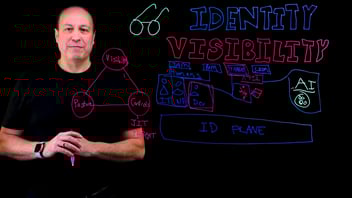
Now, in most environments, you have your identities, right? Let's start with the heartbeat users, those things called humans. I think we're all familiar with humans, right?
These include your IT admins, right? People who kind of run things, your infrastructure, your network, your applications.
But they also include your workforce users, not to forget those employees and contractors, part-time employees, and your developers.
Now, there are other identities, but these are the really important ones in your workplace from a human standpoint.
And of course, humans have been around for a long time, so we understand them.
But equally, you know, non-human identities, or NHI, is a term you may have heard.
NHI has also been around for a long time. Service counts are not new. They've been around for decades.
But in these environments where workloads are shifting out of data centers and into cloud environments, development platforms are going in the cloud environments, and so forth, we're seeing an absolute explosion of these types of identities.
So workloads, these are things like containers and virtual machines. We're seeing API keys, you know, we're even seeing things, OT operational technology and IoT, you know OT something fails there or gets compromised, a valve gets stuck in a factory, you know, that can have some real-world implications.
So non-human identities…and then of course, what's everyone talking about today?
A little acronym here called AI. Everyone's interested in what those AI agents are, those agentic agents, the models like LLMS, and there's even these things called the connectors, model context protocol.
Those are like the APIs for AI. They connect things together. They connect a server with a client securely. And if you're not seeing this whole picture of identity risk, you're not seeing everything in real time, then you're not getting the full picture of what's going on.
Because, for example, AI systems, agents can create other sub-agents, which will then inherit their access rights and privileges. Now when this agent goes away, does this agent still exist?
Maybe. We don't know. A lot of people don't know. And that's why it's really important to introduce something called the identity control plane, also known as the identity graph. OK, it spans the entire plane of your identity existence here. Identity control plane. And what this means, it's not just a bunch of data like all your identities thrown in there, it's intelligence.
It's a prioritized list of identity risk for you to understand all the identities in your environment, what their identity posture is and the relationships between those. So for example, for your service accounts, do you know who the IT admin is who owns those service accounts and is responsible for them? Maybe. Maybe not.
An identity control plane allows you to see that relationship. Do you know, for example, for your model, your LLM here, what it has access to and what it has access to after that, what it can get access to? And this is important because if any one of these identities is compromised, as we know, that can lead to catastrophic results.
So an identity control plane is something that Delinea gives you. It's not a bunch of data, but it's actually relational information, intelligence on these identities, what they're doing, their posture.
And now you can go in front of your board and say “We have control over all these identities.
We see them when they're born. We know what they're doing. We know what they have access to.”
And that's very powerful, because you can then say to your board “For AI, we can move forward because we're seeing AI. We have controls in place for just-in-time access. We have controls in place for understanding the entitlements and what they can get to, and we can manage that effectively.“
This is what we do at Delinea. So, if any of this looks familiar to you, or appeals to you, reach out to us.
We'd love to have a conversation with you. Or please visit delinea.com for more information.