Why identity visibility is foundational to any security program
If you can’t see the non-human identities (NHI) and AI in your environment, you can’t secure them. Find out why this is such a big problem and how you can use a three-step approach – discover, posture, and control – to achieve the breakthrough in your identity security program.
Let's talk about identity visibility. Now this is a topic that's getting a lot of attention these days, particularly among the board and CISOs who are responsible for risk in an organization and for very good reasons.
Identity sprawl, particularly among non-human identities and AI, is exploding, and organizations are really grappling with how to get their arms around, assess the risk of those identities, and understand what those identities have access to and what they can do ultimately if, unfortunately, they're breached by the bad guys.
So let's dive into this topic here of identity visibility with the purpose of understanding how we can mitigate and get our arms around the risk associated with those.
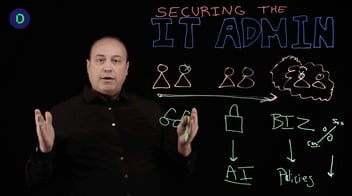
Now in a typical environment, you're going to have your human users which include IT, which include workforce users, which are employees, part-time employees, contractors, etcetera. And you're going to have developers. And these are the humans, right?
We're used to humans, heartbeat users.
But you have these other things out there, non-human identities, and non-human identities have existed for a very long time. So they're not new. NHI is not new. Service accounts, for example, which are those automations you want to back up a database every day from one cloud to another, that's a service account. You want to do a workload, for example, a container. You know, these are all things that are considered non-human identities.
But this universe is expanding and exploding. It also includes devices. So you can think of any endpoint that you have out there, and more recently, of course, IoT, Internet of Things, OT operational technology, the things that open and close valves and factories and stuff—all of that fits in this category, as well as you may have heard of something else called AI, right?
Yeah, everyone's heard of AI. It's out there. It is the thing that people are talking about, and it's what the board is going to ask you as a risk professional.
How are we getting our arms around AI? How much AI do we have out there? What are we doing with non-human identities? Are we seeing everything? Do we know what they have access to? And what would happen if the bad guys breached one of these devices?
What would happen?
And a lot of CISOs feel very anxious and uncomfortable going in front of the board and trying to answer those questions.
Because today, the way organizations are handling this is with legacy tool sets.
They're deploying their traditional identity and access management tools, their traditional privileged access management tools.
Maybe you have a threat tool in there, so an ITDR or perhaps an XDR solution out there, and they're really struggling, you know, here we have an entitlement, a CIEM solution there, and they're really struggling with, you know, each one of these will see a piece of these things, but not the entire piece.
So they're getting fractured views of identity, and it's causing a lot of problems because there's no single identity plane out there where a CISO can look at it and say, yes, I understand all of my identities and I can prioritize the risk from those and point resources towards the most pressing security risks in my organization.
And this ID plane, sometimes known as a discovery plane, sometimes known as a lot of different names for that, but it's one view where a CISO can go: Here is our risk. Right?
And so at Delinea, what we do is we propose a solution that goes, it's a three-prong approach here.
The first is visibility, like we've been talking about here, but it's visibility with a purpose.
In other words, not just a data set that's dumped on your lap or in a dashboard, but prioritized identity risk.
So you see, the minute one of your agentic AI agents creates another agentic AI agent, you see all that? You see the minute a workload is created, or a service account is created, service keys and APIs, all of that stuff is now made visible.
But visibility is only one part of this equation.
Next, we move to posture, and posture is: How are we doing? Give me something that I can report to my board. Give me something quantifiable.
So identity posture is going to say, listen, you're at 55%, you know, give you a quantitative number with a dashboard you drill down on, so you can see, look, we've got 5 developers that are in our dev environment here in our cloud that are Internet-facing without multi-factor authentication.
Now that sends people running from the room. Yeah, rightly so. And this is part of identity posture.
So you can see and point your resources towards the most pressing needs here.
And finally, we offer controls, and these are policies and technologies that you can apply here.
Things like just-in-time—JIT.
So you can say we're going to have, instead of these non-human identities in our development environment, having long-standing privileges, we're going to shrink that down, only grant privileges when that workload or when that container needs it, and we have it time-bound, and then pull those away.
So if by chance any of these identities were compromised, they wouldn't get very far. But it includes other things as well.
So, for example, once you're seeing everything, you understand its posture, and the control you might apply is threat. And do so at greater level than what you have up here with your existing threat solution.
So this threat looks across your vast infrastructure, associates all these identities, for example, do you know who the human owner of your AI models and agents and large language models are?
Probably not. Or even your non-human identities.
Well, with threat, you can associate those things and understand where those threats correlate behaviors and understand where these vulnerable identities, and automatically fix them before they're compromised.
So Delinea does this.
We help you gain visibility, understand your posture and improve it over time, and give you the controls you need to regain control over your identity visibility and your identity security environment.
If you have any questions, visit delinea.com.