Artificial Intelligence is reshaping how organizations operate at a rapid pace few technologies have matched. Some organizations are experimenting, while others have embedded AI systems and agents across workflows, products, customer interactions, and decision-making processes.
As organizations adopt new technologies to accelerate growth, responsible governance provides guardrails and controls to reduce risk. Yet in the case of AI, governance is not only lagging; it’s being overlooked.
For security, risk, and compliance leaders, this gap translates into unmanaged risk at scale. The need for responsible AI governance is not optional or aspirational; it's a business requirement.
In this blog, we'll explore the current state of enterprise AI governance, highlighting where companies are succeeding, where they are not hitting the mark, and best practices for implementing a strong enterprise AI governance program.
"The current generative AI adoption rate of 54.6% exceeds the 19.7% adoption rate of the personal computer three years after the first mass-market computer, and the internet's 30.1% adoption rate three years after the internet was opened to commercial traffic." — Federal Reserve Bank of St. Louis, November 2025
AI adoption: A familiar pattern with higher stakes
AI may feel like a shiny new ball, but organizations have faced transformative technology waves before. Remember ERP software, client/server, Y2K, the Internet, BYOD, SaaS, GDPR compliance? The list goes on and on. In each case, the companies that were successful in adopting these new technologies recognized a common truth: the adoption of these technologies was not ‘just another IT project.’
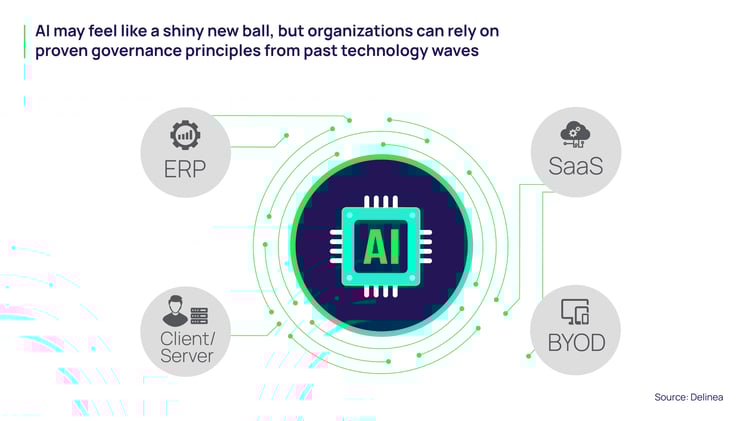
It represented a strategic business enabler, and as such, was an enterprise-wide project requiring oversight from the CXO level down, along with executive sponsorship and cross-functional alignment. Steering committees with departmental representation were required to oversee the adoption of these new technologies.
Organizations adopting AI need a formal AI Governance Committee to provide the accountability and coordination required to manage regulatory and operational risk. It operates like a steering committee but is focused on responsible AI governance and overseeing an enterprise AI governance program, with representation from finance, IT, operations, product, sales, marketing, legal, plant, supply chain, and more.
For many companies, this cross-departmental governance approach and involvement were how they successfully implemented their first enterprise business application, whether it was an ERP/finance application, a CRM application, or an HCM application.
Another way enterprises can successfully manage AI adoption is by creating a Project Management Office (PMO). The PMO oversees the project and reports to the AI Governance Committee, providing strong controls for managing sizable projects.
Companies can also be successful when the legal team takes the initial lead. For enterprise AI governance, the legal team, along with executive oversight, would work closely with IT and other departments as the governance program is developed.
Establishing an AI Governance Committee with executive oversight and cross-functional representation is a responsible approach to defining how AI governance will be conducted. Legal teams often initiate policy development, but governance must extend beyond documentation to define processes for reviewing, approving, monitoring, and auditing AI systems.
Leading organizations are:
-
Establishing a formal statement of responsible AI use policies
-
Publishing internal and external statements of AI principles for review and approval
-
Defining risk classification models for AI systems
-
Assigning accountability for AI lifecycle oversight for ongoing monitoring
Visibility first: Addressing the rise of shadow AI
One of the most immediate governance challenges is visibility.
AI impacts all parts of your business. Your employees are experimenting with AI solutions to improve efficiency. Business units are integrating AI into your products, including customer-facing tools that make your product easier to use and answer product questions more quickly. Vendors are adding AI features by default. While AI can be a key business enabler, it also presents a huge risk.
This leads to the question: How can a company have strong enterprise AI governance if it doesn’t know where AI is being used and what internal and external risks that usage drives?
This has created a new risk category: shadow AI.
Remember shadow IT during the COVID-19 pandemic? As employees sheltered in place and worked from home rather than a central office location, companies struggled to secure enterprise infrastructure, hardware, end devices, and other resources employees had downloaded. Many of these tools were SaaS-based, had not been approved by IT, and posed a range of challenges, from data privacy to security.
Successful companies identified shadow IT as a large risk to the enterprise, not ‘just another IT project’. Led by IT and Information Security, they put processes and tools in place to inventory shadow IT applications, review the risks each application posed individually, and mitigate those risks where appropriate.
The lesson from shadow IT is clear: you can’t govern what you can’t see. Strong enterprise AI governance begins with visibility: understanding where and how AI is used across the company and the risks associated with that use. Shadow AI refers to unsanctioned or unmanaged AI tools, and the unknown risks that come with the use of AI.
This blog post goes into more detail: Shadow AI risk: Navigating the growing threat of ungoverned AI adoption
Enterprises successfully addressing shadow AI risks are deploying tools to inventory AI usage across applications, platforms and AI agents. Comprehensive visibility is the foundation to reduce risk and enforce responsible governance.
To learn more about the 5 steps in a successful framework for securing AI agents, read my recent blog Securing AI agents in business applications.
Training and awareness: Governance beyond documentation
Policy without awareness fails.
Once responsible AI policies for internal use and a statement of responsible AI for external use are defined, organizations must educate employees, partners, and customers to embed them into workforce behavior. The good news is that this can again follow similar approaches used in the past for adopting and deploying new technologies.
One of the best reference points for training and awareness is data privacy programs. Privacy regulations like GDPR, CCPA, CPA, and many others forced companies to develop and implement strong programs around data privacy, supported by recurring training and awareness.
A similar approach can be used with enterprise AI governance, and should not be overlooked as part of responsible AI governance. Train your employees annually on the responsible use of AI, and do the same with your partners and customers. The enterprises that are successfully addressing AI governance from a training and awareness perspective are not developing new training and awareness processes; they are just incorporating AI into established training programs.
Responsible AI governance enables growth
We've covered several important components of an enterprise AI governance program. While these elements are critical, they are not the only requirements for a responsible governance framework. They do, however, demonstrate that organizations don’t need to start from scratch when developing processes and procedures to govern the secure use of AI. Proven governance models and control strategies already exist. They simply need to be adapted to the realities of AI.
Don't be afraid to rely on past successful approaches when deploying new technologies. AI, no doubt, is a shiny ball, maybe the shiniest new technology ever, but its governance does not need to be designed from scratch to identify and mitigate AI risks.
Read our recent whitepaper, Securing the Use of Generative AI Technologies, to learn more about the key elements of a strong AI governance framework and strong controls to implement.

WHITEPAPER
Navigate the future of AI with confidence