Enterprises, agencies, and similar organizations must now manage more identities than ever. While the growth in human, machine, developer, service, and now AI identities enables innovation, it also increases exposure to cyber threats.
Identity risk is growing faster than organizations can control it.
This theme, backed by data from Delinea and industry research, isn't meant to be alarming. These stats are meant to be familiar:
-
86% of breaches involve compromised privileged credentials (Verizon DBIR 2023).
-
71% increase in attacks using valid credentials year-over-year, with valid account abuse becoming the most common entry point for attackers (IBM X-Force Threat Intelligence Index 2024).
-
Over 80% of hacking-related breaches involve stolen or weak passwords (ITGlue, password rotation).
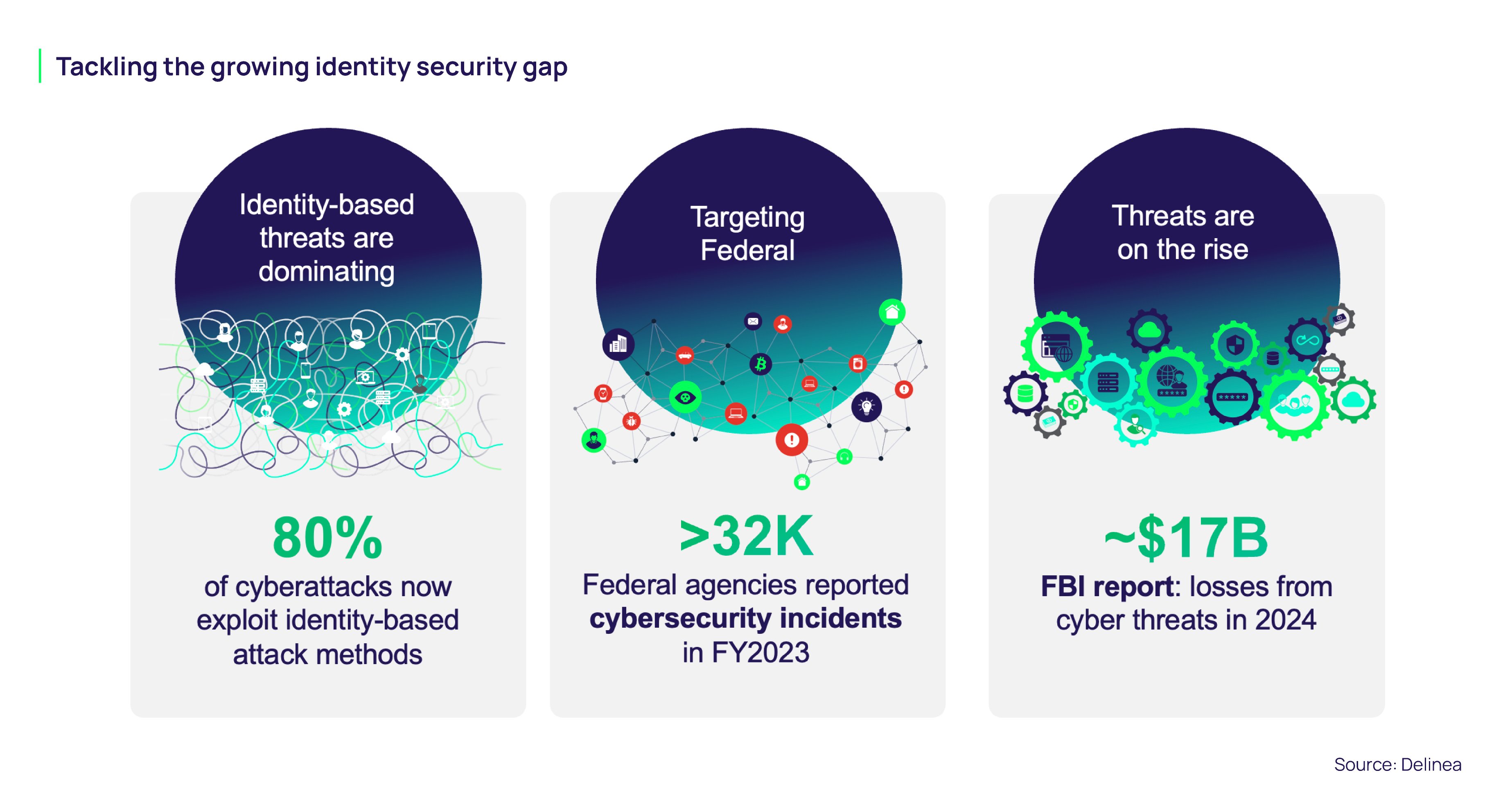
These consistent patterns show that identity risk isn’t just increasing, it’s outpacing architecture.
Here's why identity risk is growing
Identity risk is growing because identity has outpaced the architecture designed to secure it. Three fundamental forces are driving the identity security gap:
1. Explosion of identities
We’ve moved from managing hundreds or thousands of users to millions or billions of identities, including machines and AI agents that authenticate and act autonomously.
2. Changing threat landscape
Most identity programs were built to pass audits, not to stop real-time abuse. Meanwhile, attackers have shifted tactics, using credential theft, reuse, and automation to infiltrate environments that look compliant on paper but are fragile in practice.
3. Tool complexity and inefficiency
The average enterprise runs dozens of security tools, and many are designed to solve narrow identity problems in isolation. No single tool sees the whole picture, creating fragmentation and blind spots.
Identity chaos meets zero trust imperatives
Many security teams describe their environment as chaotic: Too many accounts. Too many permissions. Too little confidence.
This aligns with broader trends, especially in the public sector, where zero trust is rapidly becoming the cybersecurity standard. Zero trust shifts the mindset from perimeter defense to continuous verification and least privilege. As defined by the U.S. Department of War.
Zero trust is much more than an IT solution... it requires integration of capabilities, technologies, solutions, and processes across architectures, systems, and execution plans.
Federal directives, including the 2021 Executive Order on cybersecurity, require agencies to adopt zero trust frameworks, with implementation deadlines like the end of FY2027 for DoW and similar expectations across civilian agencies. CISA’s zero trust guidance provides a roadmap, but each organization must identify partners and tailor their path forward.
Zero trust is no longer optional; it’s the baseline for modern cybersecurity.
Commitment to federal and regulated industries
While guidelines such as CISA’s Zero Trust Maturity Model provide some support, it is up to each agency to identify technology partners and determine its best path forward. CISOs, Program Managers, and similar roles supporting federal government missions are under increasing pressure to meet zero trust mandates within upcoming deadlines.
Executive Order 14028 acknowledges and encourages a partnership between the public and private sector to assist government agencies in their architecture overhaul and modernization.
While many competitors are deprecating on-premise versions of Secret Server, Delinea remains committed to federal clients and regulated industries that require local control. Secret Server is currently advancing through the FedRAMP High Authorization process to support cloud deployments that meet stringent government requirements, while ensuring on-premise options remain for those who need them.
Beyond this, Delinea also supports Identity, Credential, and Access Management (ICAM) initiatives in alignment with zero trust. An ICAM stack has everything needed to control identities and privileges within an organization. To meet zero trust initiatives, agencies are putting together ICAM stacks. Delinea supports ICAM initiatives by integrating with vendors such as Okta, Ping, Sailpoint, and Splunk to keep the framework streamlined and straightforward.
Last, and certainly not least, to support federal accounts, Delinea is actively working toward additional certifications.
If you’d like to talk more broadly about how Delinea’s software suite can address regulations and standards that you’re trying to tackle, reach out to discuss more today.
FREE EBOOK
How to secure identities with zero trust